








The Unified Revenue Data Model

A tracking pixel for every revenue interaction.

GTM Engine continuously captures what buyers and customers do, understands what those interactions mean, and connects every signal to one living account, contact, opportunity, and customer history.

Revenue event stream

Every interaction. Continuously observed.

Tracking live
EmailNo reply · 3rd touch
MeetingPricing discussed
WebEnterprise page viewed
CampaignWebinar attended
SupportFeature workflow question
RevenueSensor

Structured in real time

Account

Adobe · Enterprise

Hot

Contacts

4 people engaged

+3

Opportunity

Expansion · $180K

Risk

Intent

Buying committee forming

92
Activity becomes durable context, not another disconnected event log.

01 · Capture

A tracking pixel for your entire revenue motion.

Website pixels observe digital behavior. GTM Engine observes the complete revenue journey: emails, meetings, calls, campaigns, forms, product signals, support tickets, and CSM touchpoints, then connects every event to the people and revenue records involved.

Revenue tracking surface

6 systems connected
1Campaign engagement
2Sales conversations
3Customer touchpoints
4Product & support

Continuous capture

Revenue interaction ledger

100%

identity linked

Live

context updates

02 · Interpret

We track what happened and understand what it means.

An activity count cannot tell you whether a deal is healthy. GTM Engine analyzes content, sequence, participants, sentiment, and context to distinguish risk from intent and isolated leads from account-level demand.

Account intelligence

Intent recalculated
Adobe

Account

Adobe

Red hot · 92
Maya Chen

Maya Chen

Contact us form

Jordan Lee

Jordan Lee

Webinar attended

Sam Ortiz

Sam Ortiz

Whitepaper downloaded

Alex Kim

Alex Kim

Pricing page viewed

Negative signal

3 emails. No reply.

Engagement decay flagged

Context positive

Feature support ticket

Expansion evidence found

Account intent

4 engaged contacts

Buying committee forming

03 · Connect

One offhand comment can change the next best action.

A champion’s comment to their CSM should not disappear inside a call note. The shared model can connect that signal to an opportunity owned by Sales, flagging an expansion risk or revealing a new upsell motion while the context is still fresh.

Shared cross-team context

Signal routed

CSM conversation · Today

“The team loves it, but we may consolidate vendors unless the analytics workflow can cover Finance.”

Maya ChenMaya Chen · Champion

Expansion risk

Vendor consolidation mentioned

Upsell opportunity

Finance analytics use case

Sales opportunity updated

Platform Expansion · $180KRep alerted

04 · Resolve

One person. One record. Their full history follows.

GTM Engine cleans, deduplicates, and merges CRM records into a durable identity. When someone changes companies, the person and their engagement history stay connected, while account relationships update, so no hard-won context is lost.

Identity resolution

3 records merged

CRM

Possible duplicate

Maya Chen

maya@northstar.io

Campaign

Possible duplicate

M. Chen

maya.chen@gmail.com

Support

Possible duplicate

Maya C.

Account #4821

Maya Chen

Maya Chen

Canonical contact · Verified

2024

Northstar

Webinars · 8 sales calls · Customer

2026

Acme Corporation

New role detected · History retained

47 historical interactions preserved across company change

The automation layer

Signals enter. Workflows and agents decide. The system acts.

Triggers detect change. Workflows execute repeatable logic. Agents interpret context and choose the right next step. Every run produces structured data or a controlled action.

Automation run

One shared data model drives every decision and action.

Governed and observable

Triggers

Something changes

1Record changedStage, owner, field, or status
2Signal detectedIntent, risk, reply, or ticket
3Time reachedSchedule, SLA, renewal, or manual run
Starts

Workflows + Agents

The execution and judgment layer

Workflows

Run repeatable logic, branches, enrichment, field updates, and multi-step processes.

Agents

Interpret context, make bounded decisions, and select the right workflow or tool.

Both read from and write back to the same revenue model
Produces

Outputs

Structured data and action

Structured data

CSM handoff document
Account brief
Deal and health fields

Actions

Enroll in campaign
Send email or Slack
Create task or alert
Create or update record
VersionedDraft and published logic
InspectableInputs, steps, and outputs
GovernedPermissions and run history

The analytics layer

Ask in plain language. Build the report. Add it to the dashboard.

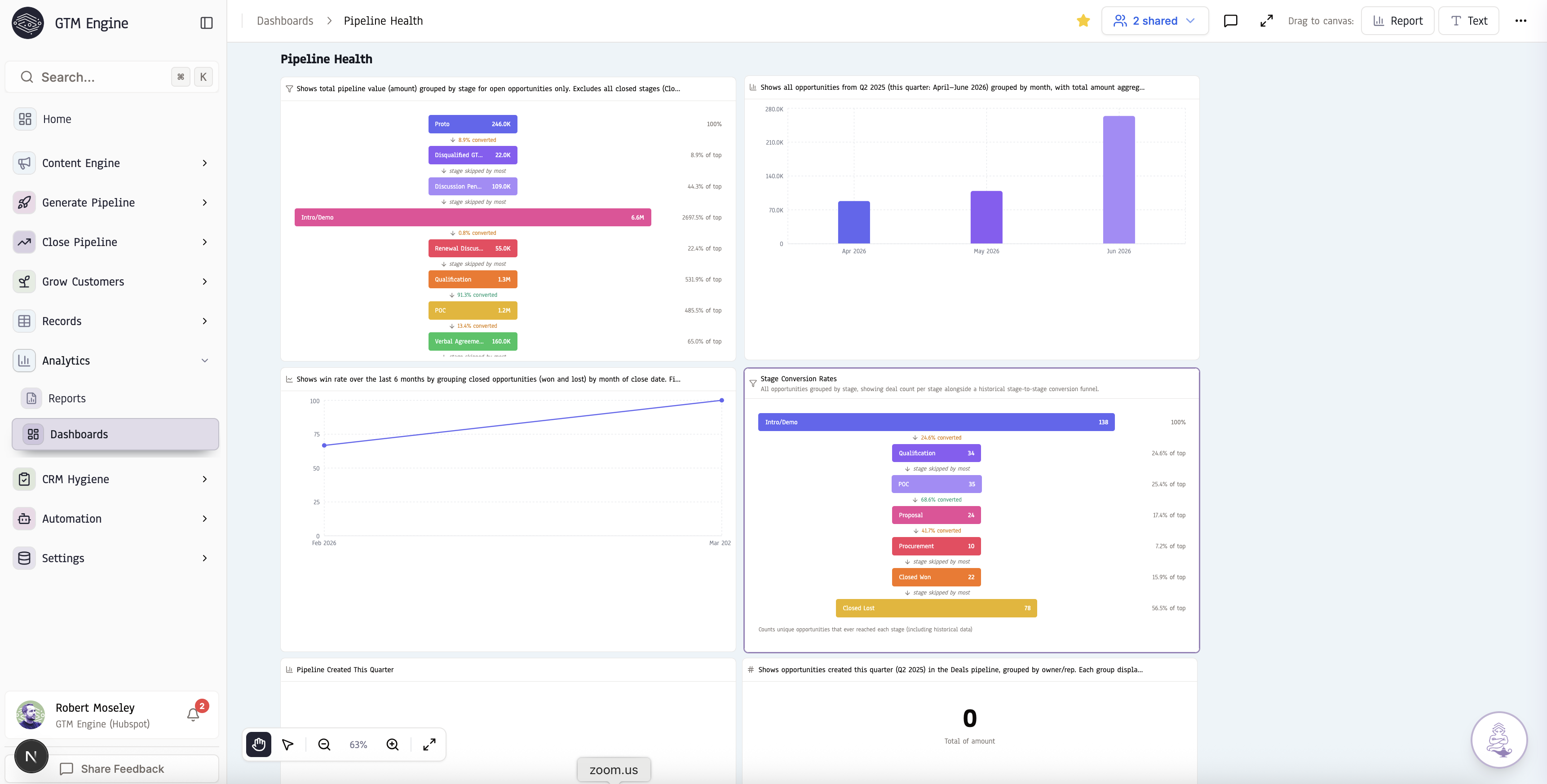
Turn a GTM question into a live report without waiting on an analyst. Refine the result, save it, and add it to a dashboard that stays current as your revenue data changes.

Step 1

Ask a question. Generate the report.

Step 2

Drop the report into a live dashboard.

GTM Engine pipeline health dashboard containing multiple reports
Ask naturallyDescribe the records, filters, grouping, and metric you need.
Create the reportPreview, refine, save, share, and run workflows on the result.
Operationalize itAdd reports to dashboards that stay current as the model changes.

Why GTM Engine

Not another system to inspect. A system that keeps GTM moving.

GTM Engine connects intelligence, operational data, and action inside the tools and processes your teams already depend on.

Comparison 01

Against CRM alone

The CRM, finally kept current.

×

Typical approach

A CRM is only as complete as the fields reps remember to fill in and the judgment they apply.

With GTM Engine

GTM Engine analyzes every new interaction and syncs structured fields to your CRM in real time. It does the work inside the system your team already uses, not in a replacement database.

Every field refreshed from evidenceNo manual entry or subjective rep updatesReal-time, bi-directional CRM sync

Comparison 02

Against BI tools

The answer can take action.

×

Typical approach

BI tools explain what happened after data has been modeled, loaded, and added to a dashboard.

With GTM Engine

GTM Engine reports on the same live model that powers workflows and agents. A filtered segment can immediately update records, notify a team, enroll contacts, or launch the next process.

Live operational dataNatural language to reportRun workflows on any segment

Comparison 03

Against AI chatbots

Intelligence that persists.

×

Typical approach

A chatbot produces an answer that disappears into a conversation and cannot operate the revenue process.

With GTM Engine

GTM Engine writes typed, inspectable intelligence back to accounts, contacts, and opportunities. The output becomes durable context for every report, workflow, agent, and team.

Structured fields, not chat debrisSource evidence retainedVersioned and governed execution

Comparison 04

Against RevOps point tools

One operating layer, not more plumbing.

×

Typical approach

Every point tool solves one workflow while creating another data silo, sync, vendor, and process to maintain.

With GTM Engine

GTM Engine uses one model across pipeline generation, deal execution, CRM hygiene, content, and customer health. Every motion contributes context back to the others.

One identity and activity historyShared workflows and agentsCross-team signals by default

Common questions. Direct answers.

A revenue platform should stand up to scrutiny.

GTM Engine does not require a rip-and-replace project, perfect data, or blind trust in AI. It gives your existing systems a shared intelligence and action layer, with a practical path to start.

The adoption path

One use case. One measurable outcome. One model that compounds from there.

01System of recordWe already have a CRM.+

That is the point. GTM Engine works inside your CRM strategy rather than asking you to abandon it. Every new call, email, meeting, campaign response, and customer interaction can refresh the fields your teams depend on, without waiting for a rep to remember what to enter or how to interpret it.

Keep the CRM. Make it complete, current, and operational.

02Existing stackWe already have Gong, Outreach, BI, and enrichment tools.+

Those systems produce valuable signals, but each one sees only part of the revenue journey. GTM Engine connects their outputs to persistent accounts, contacts, opportunities, and activities. A conversation signal can update a forecast, change an account score, notify Customer Success, and trigger a workflow instead of remaining trapped in the tool that captured it.

Your existing tools become inputs to one shared revenue model.

03AI trustAI-generated data cannot be trusted.+

AI should not be trusted as an unexplained black box. GTM Engine turns analysis into typed, inspectable fields with source context, then makes those values editable and governable. Teams can see what evidence produced a signal, control how it is used, and keep human approval wherever the decision requires it.

Use AI as governed operational data, not unquestioned output.

04Data qualityOur CRM data is too messy for this to work.+

Messy data is a reason to start, not a prerequisite to delay. GTM Engine resolves identities, detects duplicates, merges records, maps activity to the right people and accounts, and continuously refreshes fields as new evidence arrives. The model improves while it operates instead of relying on a perfect cleanup project first.

Clean and activate the data in the same operating layer.

05ImplementationThis sounds like a long transformation project.+

It does not need to begin as an all-at-once replacement program. Start with one high-value motion, such as CRM field automation, pipeline inspection, account intent, or customer handoffs. Connect the required records and signals, prove the workflow, then expand on the same model without rebuilding the foundation.

Start narrow. Let every additional use case compound.

06AdoptionOur teams will not adopt another tool.+

Much of the value happens without asking sellers, marketers, or CSMs to change how they work. GTM Engine captures interactions, updates records, and routes signals automatically. When teams do enter the platform, they see purpose-built views for the outcome they own rather than another generic database to maintain.

Automate the work first, then improve the user experience.

07ControlHow do we govern what agents and workflows can do?+

Automation needs operational controls. Workflows and agents use defined tools, permissions, versions, draft and publish states, diagnostics, and run history. Teams can inspect the inputs, steps, outputs, and failures, then reserve sensitive actions for explicit approval.

Give automation boundaries, visibility, and accountability.

08Internal buildCould our RevOps or engineering team build this?+

Individual pieces can be built internally. The difficult part is maintaining the identity graph, source integrations, activity history, typed intelligence, CRM sync, workflow runtime, agent tools, reporting, governance, and team-facing applications as one reliable system. GTM Engine lets your team configure the revenue logic instead of owning the platform beneath it.

Build your unique GTM process, not the underlying infrastructure.

09Platform sprawlIs this just another platform to add to the stack?+

A point tool adds one more isolated workflow. GTM Engine is designed to consolidate the shared data and execution layer beneath multiple revenue motions. Pipeline generation, deal execution, RevOps, content, and customer success all read from and contribute to the same model, reducing duplicate logic and disconnected context.

Add one foundation that can replace many disconnected layers.

Unify your GTM data. Turn it into structured intelligence. Act on it everywhere.

See how GTM Engine turns every revenue signal into actions across pipeline generation, sales execution, RevOps, content, and customer success.