

TL;DR
Plenty of forecast deals have a name in the Champion field and nothing behind it. If you want to build a champion list you can defend, every name needs a dated action, a source, a confirmed current employer and a date when someone checks it again. Without those, the label is a seller's mood written down in the CRM.
Here's what you'll learn in this article:
- Why a deal champion and a customer advocate need separate records, and what goes wrong when one field holds both
- The minimum fields a champion list needs before it survives a pipeline review
- How current employer and evidence freshness decide whether a champion label still holds
- How the champion list fits inside a stakeholder map, and which deal questions it cannot answer
A champion is an internal advocate whose actions advance a buying decision
If your reps call everyone who replies quickly a champion, your forecast is counting friendliness.
A champion is an internal advocate at the buying company who uses their own influence and access to move a purchase decision forward. The definition turns on action. A contact who joins every call, laughs at the right moments and replies within an hour is engaged. That person becomes a champion once they do something inside their company that the seller could not do alone: book the meeting with the economic buyer, share the internal evaluation criteria, or defend the project when someone else wants to delay it.
To be clear about scope, this guide covers deal champions in B2B sales. It is not about sales leaderboards, "Champion" software products, or the general idea of a fan of your brand. The search results for "champion" mix all three, which is part of why CRM fields end up meaning different things to different reps.
Our working rule is simple. If nobody can name the action, the date and where the evidence lives, the contact is not a champion yet. That rule is a practical recommendation from how we run deal reviews, not a validated industry benchmark. It is strict on purpose, because a soft definition fails exactly where it costs the most: the late-stage deal that slips because the "champion" never had access to the person who signs.
A deal champion and a customer advocate are different records
When one CRM field holds both meanings, nobody can tell whether a name helps this quarter's deal or next year's reference call.
A deal champion works inside an active buying process. A customer advocate is someone who already uses your product and promotes it: they take reference calls, make referrals, or push for things they want the vendor to have. Both are valuable. They answer different questions, and a single "Champion" checkbox flattens them into one.
We see the distinction in our own calls. In an October 2026 conversation, a current GTM Engine user offered to introduce our team to a potential customer and said he keeps advocating for a Salesforce AppExchange listing because several of his own clients were waiting on it. That is customer advocacy, real and useful. It tells us nothing about who is driving the decision inside the account he referred. Somebody at that company still has to become the deal champion, and that person has to earn the label with their own actions.
The operational fix is to keep two attributes. One records the contact's role in a specific open opportunity (champion, coach, evaluator, blocker, unknown). The other records the contact's relationship to your company over time (prospect, customer user, advocate, former customer). A former champion who changes jobs can then show up as a warm relationship at a new account without being silently promoted to champion of a deal they have not touched.
A champion list you can defend records proof, not just names
A list of names with a checkbox cannot answer the first question a sales leader asks: "How do you know?"
A defensible champion list is a record of internal advocates where each entry carries its own evidence. The structure below is the version we recommend. Treat the field set as a starting template you adapt, not an industry standard.
| Field | What to record | Hypothetical example (labeled, not a real deal) |
|---|---|---|
| Contact and account | Name, title, account, opportunity | Director of Sales Ops, hypothetical mid-market SaaS account |
| Role in this deal | Champion, coach, evaluator, approver, blocker, unknown | Champion (emerging) |
| Current employer confirmed | Yes or no, plus the date and source of the check | Yes, confirmed from her email signature on a dated thread |
| Observed advocacy | The specific action, stated as a fact | Forwarded our security questionnaire to the IT lead and booked the review |
| Evidence source and date | Call, email, meeting invite, with a date | Calendar invite, dated |
| Influence and access | Who they have demonstrably reached | IT lead (observed); CFO (unknown) |
| Motivation | What they gain, in their words if you have them | Not yet stated; flagged as unknown |
| Status | Unvalidated, emerging, validated, reassess | Emerging |
| Next validation action and owner | One action, one owner | AE asks her to set up a 20-minute call with the CFO |
| Reassessment trigger | The event that forces a re-check | Missed CFO meeting or any change in her title |
Two habits make the table work. First, write the observed action before the conclusion. "Forwarded our security questionnaire to the IT lead" is checkable. "Very bought in" is a feeling. Second, let "unknown" be a legitimate answer. A field marked unknown tells the deal team exactly what to go find out. A field filled with a guess hides the gap until the deal slips.
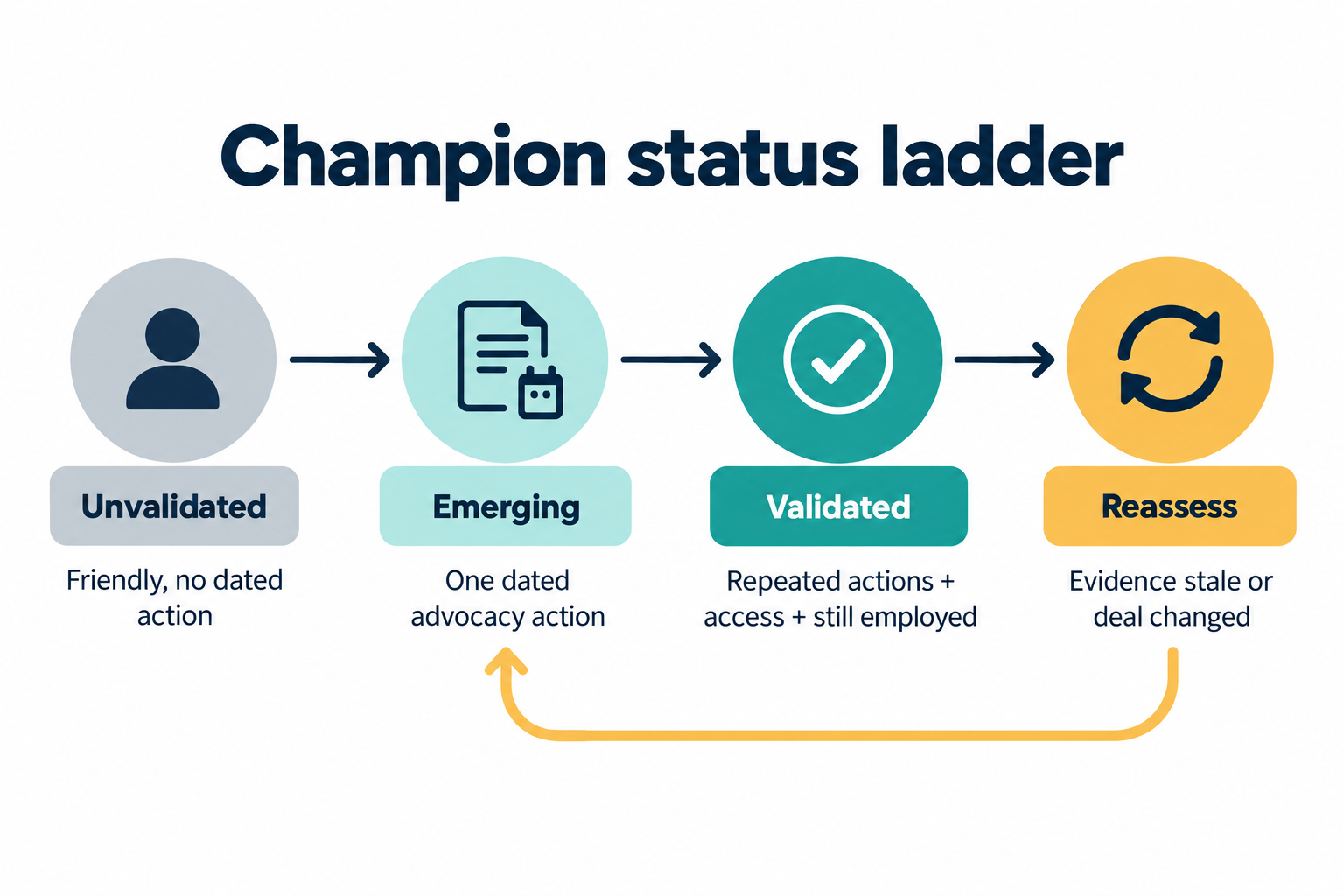
Status is where judgment lives, so define the moves in writing. A contact goes from unvalidated to emerging after one dated advocacy action. Emerging becomes validated once there are repeated actions, demonstrated access to at least one decision-maker, and a confirmed current employer. Any status drops to reassess when its trigger fires.
Champion validation depends on observed advocacy and access
Reps hear "I'll push this internally" on every other call. The question is whether anything got pushed.
Champion validation is the process of testing a contact's advocacy, influence, motivation and access against things they actually did. Behavioral tests are useful here as prompts for gathering evidence. They are not a scoring model that predicts the deal outcome, and they should not be sold internally as one.
 Start with access, since it is the easiest to observe and the most frequently assumed. Did the contact bring another stakeholder into a meeting, or forward material to someone you have not met? Then check advocacy: did they share internal context you could not get elsewhere, such as the evaluation criteria, the approval path, or the competing project fighting for the same budget? Influence shows up when other people at the account repeat the contact's framing back to you. Motivation is the hardest to see. Record it only when the contact states what they personally gain, and quote them if you can.
Each action gets logged the same way: what happened, the date, the source, and the next step it created. A useful test for the log is whether a peer who missed every call could read the entry and agree with the status. If they would need the rep in the room to explain it, the entry is not finished.
A failure mode generic advice skips: the overly helpful coach. Some contacts share a great deal of information because they like you or dislike the incumbent vendor, and they have no pull with the people who decide. They score well on enthusiasm and poorly on access. Keep them in the record as a coach, value what they tell you, and keep looking for the person who can move the decision.
Current employer and evidence freshness decide whether the label still holds
A champion who left the company in August is still a champion in your CRM until someone notices.
Evidence freshness is the age of the most recent observed action supporting a champion label. Current employer is the most basic freshness check, and the one most likely to fail quietly. When a champion changes jobs, the open deal loses its advocate and the CRM keeps reporting one.
Buyers are paying attention to this. In a September 2026 demo, a marketing team at Connectbase told us they wanted to identify champions who move to new companies. Their questions in the same call were the right ones: which data sources sit behind job-change detection, and what accuracy rates support it. Ask those questions of any vendor, including us. A job-change alert is only as good as the data behind it and the date it was last checked.
Freshness applies to actions too. A champion who arranged a technical review in one quarter and has gone quiet since is a historical champion. We recommend recording the date of the last observed action next to the status, so that a reviewer sees "validated, last action 61 days ago" and can decide what that means for this deal. Rules about exact day counts belong to your sales cycle length. A 30-day sales cycle and a nine-month enterprise cycle should not share a threshold.
Practical reassessment triggers include a missed commitment from the champion, a title change, a new stakeholder entering the process, a change to the buying process such as a new procurement step, and a silence that exceeds what is normal for the stage. Each trigger is an operational recommendation, not a customer-backed finding. When one fires, record what changed, what is still known, and the next action to re-validate the relationship.
A stakeholder map shows where a champion sits in the buying group
A validated champion with no path to the economic buyer is a well-documented single thread.
A stakeholder map is a view of everyone who can influence, approve, support or block a decision. The champion list is the focused subset: the people advocating for you. Keep both, because each answers a different question. The list asks "who is working for this deal and how do we know?" The map asks "who else matters, and does our champion reach them?"
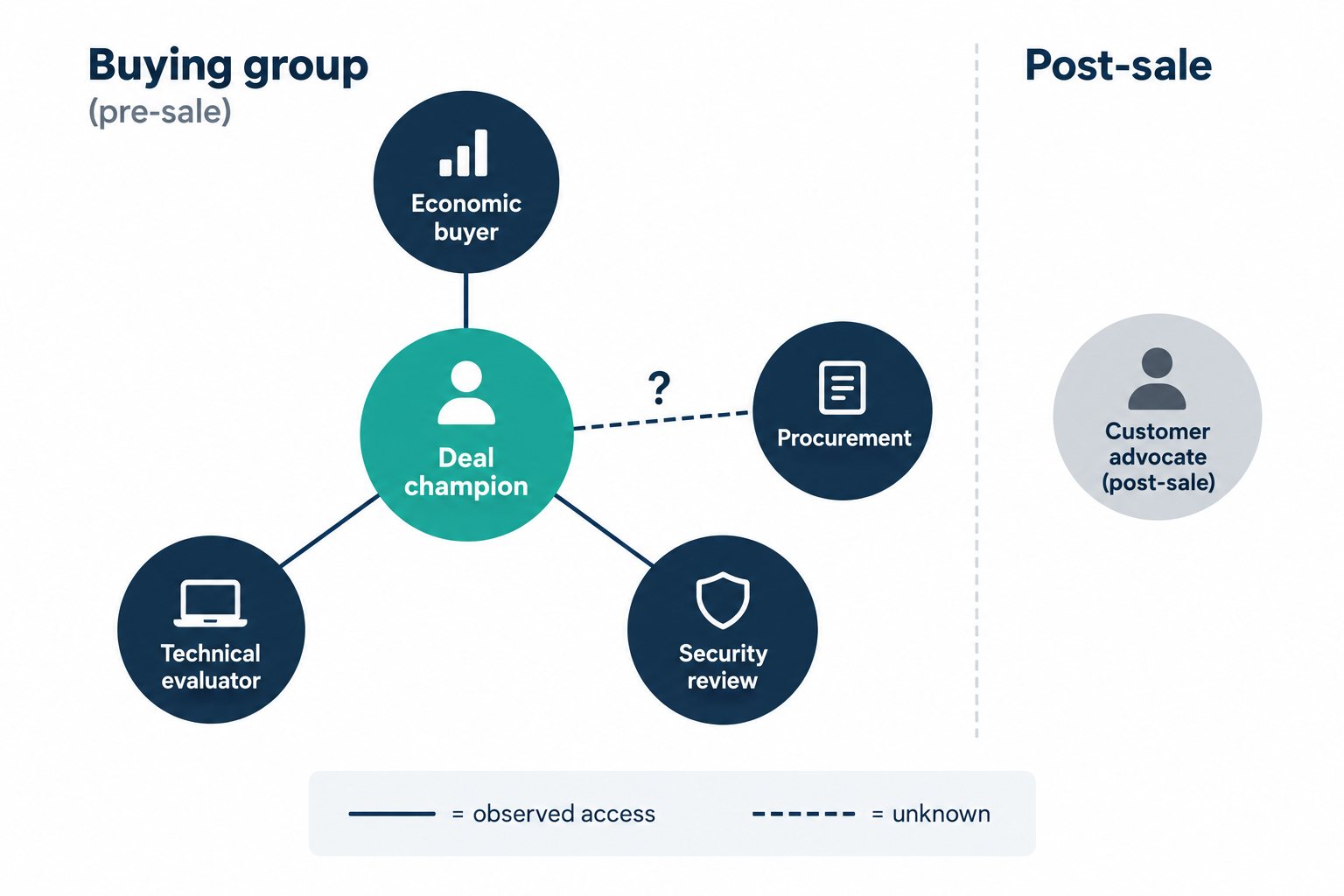 Map each person by role in the decision, level of influence, stance toward your deal, relationship to your team, and known access to other stakeholders. Draw access as observed or unknown, and never infer it from an org chart. A director who reports to the CFO on paper may not have had a real conversation with the CFO in a year.
Security review is a good place to test the map. One prospect described failing a first security review attempt as costing "another like four weeks of security review and another thousand dollars." If your champion has no observed access to whoever owns that review, the map shows the gap before the four weeks start.
On the four-quadrant chart that shows up in stakeholder-map searches: there is no single universal version. A common layout plots influence against interest or support, but frameworks label the quadrants differently. If you use a quadrant chart, write the axes and definitions on the chart itself so everyone reading it applies the same meaning.
A champion list cannot answer every deal question
A strong champion record tempts teams to treat it as proof of things it never measured.
A champion list establishes one thing: whether a specific person is advocating for this deal, with evidence. It does not prove budget, decision authority, consensus across the buying group, or a commitment to buy. Each of those needs its own supporting evidence. A champion saying "budget is fine" is a champion's claim about budget, and it belongs in the record as exactly that.
Contacts can matter without being champions. The technical evaluator who runs a fair test, the coach who explains the politics, the procurement lead who tells you the real deadline: all useful, none of them champions. Keep that distinction in CRM language. Upgrading a helpful contact to champion because the deal "needs one" is how pipeline reviews end up arguing about feelings.
When the team cannot cite a specific observed action, the honest status is unvalidated. That label sounds worse in a forecast call. It is also the only one that tells the team what to do next.
A defensible record changes what gets asked in deal review
Deal reviews stall when "who's the champion?" gets a name and no follow-up question.
The evidence standard changes the questions in a deal review. What did this contact do? When? Where is it recorded? Are they still at the company? What remains unproven? Those five questions take less time than a debate about whether someone "seems bought in," and they end with something concrete: one next validation action and one owner.
Keeping this record by hand is the real tradeoff. Logging dated actions, checking employers and refreshing statuses takes rep time, and reps resist fields that feel like admin. Our view, and the reason we build GTM Engine around evidence attached to CRM records, is that the record should be assembled from the activity that already happened (meetings booked, emails forwarded, people added to threads) and then reviewed by a human who owns the judgment. Software can surface the evidence and flag a stale label. Deciding whether someone is a champion stays with the deal team.
Your next step: take the ten largest deals in your current-quarter forecast, open the Champion field on each, and ask the five questions above. Mark every contact that fails as unvalidated and assign one validation action per deal. The count of unvalidated names is your real champion coverage.
Frequently asked questions
What is a sales champion?A sales champion is an internal advocate at the buying company who uses demonstrated influence and access to help advance a purchase decision. The label should rest on observed, dated actions, not on how friendly or responsive the contact is.
How do you test a champion in sales?Ask the contact to do something only an insider can do, such as arranging a meeting with the economic buyer or sharing the internal approval path, and record whether it happens, when, and where the evidence lives. Interest and enthusiasm alone are not proof.
What is the difference between a champion and a coach?A coach gives you guidance and information about the account. A champion takes action inside the account to move the decision forward. One person can start as a coach and become a champion, so document the behavior rather than relying on the label.
What should be included in a stakeholder map?Each stakeholder's role in the decision, influence, stance, relationship to your team, known access to other stakeholders, and next action. Mark which points are verified and which are assumptions, and draw unknown relationships as unknown.
What are the four quadrants of a stakeholder map?There is no single universal set of quadrant labels. Many charts plot influence against interest or support, but frameworks name the quadrants differently, so state the axes and definitions on the chart before the team uses it.
About the Author

Robert Moseley IV is the Founder and CEO of GTM Engine, a pipeline execution platform that’s changing the way modern revenue teams work. With a background in sales leadership, product strategy, and data architecture, he’s spent more than 10 years helping fast-growing companies move away from manual processes and adopt smarter, scalable systems. At GTM Engine, Robert is building what he calls the go-to-market nervous system. It tracks every interaction, uses AI to enrich CRM data, and gives teams the real-time visibility they need to stay on track. His true north is simple. To take the guesswork out of sales and help revenue teams make decisions based on facts, not gut feel.


