
TL;DR: A CRO who owns SDRs, Marketing, Sales, and CS is accountable for four teams that historically work off four disconnected views of the same customer. Campaign Engine replaces those views with one shared account record, so expansion, win-back, and upsell-routing playbooks can run automatically instead of depending on someone remembering to loop the next team in. That is what closes the visibility gap a fragmented point-solution stack cannot close.
At a former company, I watched an entire quarter of pipeline generation quietly stop working, and it took us too long to figure out why. We were running outbound through a market-leading cadence tool, the same one that had worked fine for years. Then it didn't. Reply rates fell off, meetings dried up, and nobody could tell if the problem was the messaging, the targeting, or something else entirely. It turned out to be deliverability: Google and Microsoft had tightened their filtering rules, and the sequencing platform we were on hadn't changed with them. Our emails were landing in spam, and we had no visibility into that until pipeline was already gone.
That is not a rep problem, and it is not really a tooling problem either. It is a visibility problem. Nobody on the team, including me, had a way to see what was actually happening to an email once it left our system, or to connect that back to the account and contact history that would have told us something was wrong sooner.
Campaign Engine, GTM Engine's unified campaign workflow, is not a deliverability monitor. It would not have caught the Google and Microsoft filtering change itself. What it changes is what happens next: Sales, Marketing, CS, and SDRs work off the same account record in real time, so a drop in reply rate shows up against the account and contact history immediately, instead of surfacing three months later as a quarter of missing pipeline.
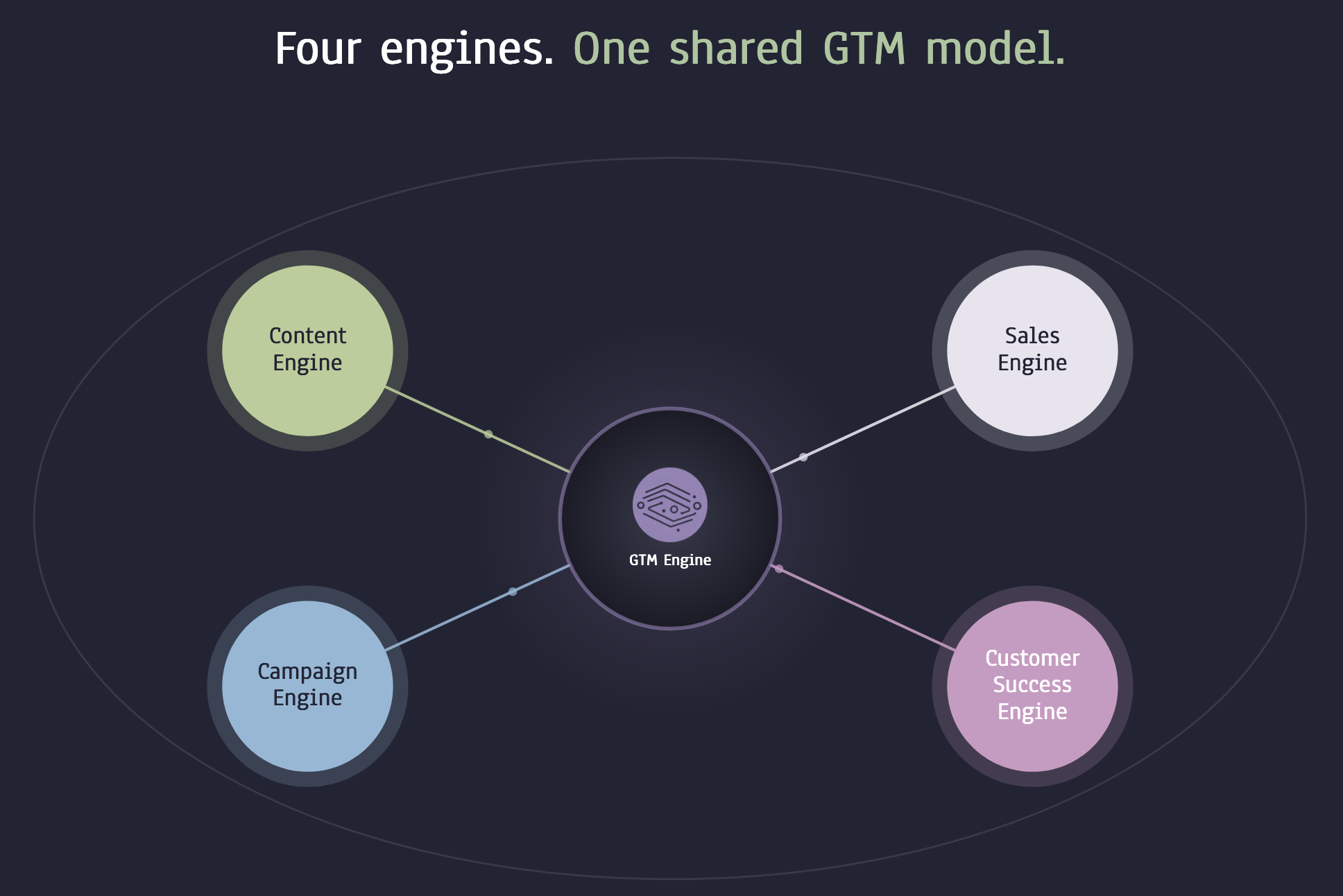
One account record, not four team-specific spreadsheets
A single source of truth is one account record that every team pulls from and writes back to, instead of four teams each keeping their own version of the same customer. HubSpot or Salesforce remains the system of record; Campaign Engine reads account, contact, and call history from it and writes enrollment, reply, and outcome data back to it, so the CRM stays authoritative and every team sees the same field values instead of a synced copy that can drift. Campaign Engine runs on that same account and contact data across every motion: outbound, inbound follow-up, consideration, win-back, closed-lost nurture, and customer lifecycle. That means a consideration campaign to a contact on an open deal pulls from what that contact actually said on a call about their pain and their interest, not a name-and-title merge field. A win-back campaign pulls from why the account actually churned. A lifecycle campaign pulls from how the team is actually using the product today, which is exactly the kind of signal a CSM hears on a call and a salesperson never sees.
That is the difference between a playbook everyone agrees to in a planning meeting and a playbook that actually runs. A shared playbook with no shared data behind it depends on people remembering to loop each other in. This does not. That's a different claim than saying every system now contains identical data. It means one governed account record is the version everyone works from, and each team still sees the fields relevant to them.
Playbooks that were not possible with four disconnected tools
Most outbound stacks today are a prospecting database, an AI writer, a sequencer, and a pile of RevOps glue holding it together. Every handoff between those tools loses the account's actual history. Campaign Engine replaces that chain with one engine, so teams can run motions a fragmented stack cannot support:
- A rep closes a deal, and the account rolls straight into an onboarding and expansion sequence built around what the rep and the buyer discussed, not a generic welcome series.
- A CSM's call surfaces an upsell signal, and the account is scored and routed to Sales automatically, instead of living in the CSM's notes until someone happens to mention it in a QBR.
- An opportunity moves to closed-lost, and a win-back sequence starts automatically, timed to when the buyer is likely to revisit the decision, built around the reason they said no.
- A reply like "check back with me next quarter" enrolls that contact in a sequence timed to do exactly that, with no task for a rep to remember and no dropped thread.
None of that requires a rep, a CSM, or a marketer to manually rebuild context for the next team. The system already has it, because every team is drawing from the same account.
Campaign Engine gives a CRO one view across Sales, Marketing, SDRs, and CS
A CRO who owns SDRs, Marketing, Sales, and CS is the only person accountable for four teams that have historically run on four disconnected views of the same customer. Sitting in that seat, I wanted one specific thing I never had: a single, trustworthy view of what is actually happening across every account, not what a rep remembers to log. Campaign Engine tracks enrollment, replies, and outcomes across every motion and syncs it back to HubSpot or Salesforce automatically, so I am not stitching together a sales tool's dashboard, a marketing platform's dashboard, and a CS platform's dashboard to guess whether the business is healthy.
That means I can see, in one place, whether a win-back motion is actually working, whether expansion sequences are converting, and whether SDRs are calling into accounts that Marketing has already engaged, instead of finding out those things were disconnected after the quarter is already over.
The efficiency case is real, but shared accountability matters more
Yes, this removes manual work: reps stop rebuilding context that already exists, CSMs stop losing signal in call notes, SDRs stop working stale lists. That efficiency matters. But for a CRO who owns all four functions, the bigger change is structural: Sales, Marketing, CS, and SDRs stop operating as four teams with four separate views of the same customer and start operating as one motion, run by one leader, off one shared understanding of where every account actually stands.
That is what a modern go-to-market org needs to look like. Not more tools bolted together. One system of record for what is actually happening with your customers, running the playbooks that fragmented tools never let you run.
Campaign Engine is available now in early access. Get in touch if you want to see it running against your own CRM data.
Craig Witt is Fractional CRO at GTM Engine.
About the Author

Craig Witt is a seasoned revenue executive and GTM advisor with more than three decades of experience building, scaling, and leading enterprise software sales organizations. He has held senior revenue leadership roles across companies including Compliance & Risks, MotionPoint, Ventiv Technology, VersionOne, TIBCO, Software AG, Business Objects, Quest Software, and OpenText. Throughout his career, Craig has led global sales teams, owned full revenue P&Ls, and helped organizations strengthen go-to-market strategy, sales execution, forecasting, and operational discipline.
As a consultant to GTM Engine, Craig brings a CRO’s perspective to helping revenue teams turn data, process, and customer intelligence into better outcomes. He is especially focused on practical ways to improve pipeline quality, seller productivity, account prioritization, and forecast confidence without adding unnecessary complexity for reps or RevOps teams. Craig is known for his direct, execution-oriented approach and his belief that strong culture, clear strategy, and consistent accountability create elite results.


