

TL;DR
Sales forecast accuracy is the distance between what you said would close and what actually closed. An evidence-based forecast closes that distance by citing itself: every change in deal health, close date, and forecast category traces back to the activity that caused it, down to the words on the call or in the email. It does not depend on a confidence percentage someone typed in during the last week of the quarter, and where the record is incomplete, the gap shows up as a gap instead of as optimism.
Your prospects build this forecast, which is why the number survives the question of where it came from.
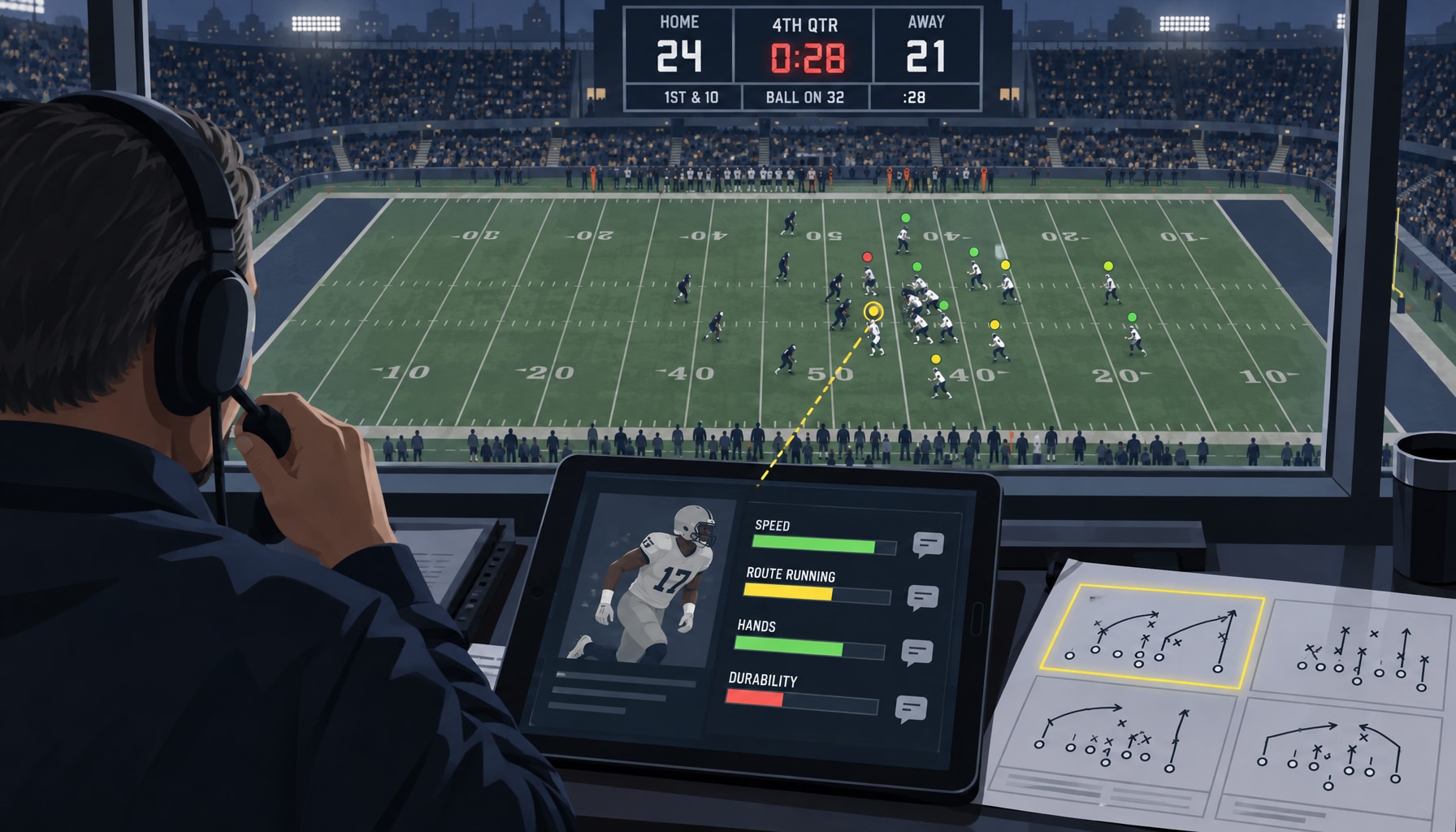
Picture the coaches' booth: the whole field, the score, the clock, and where every player is lined up. In a forecast, that is the forecast page and the pipeline view: whether the quarter is real and which deals are carrying it.
The zoomed-in view is the play you call on this snap to move the ball. Your champion is your star receiver in a good one-on-one matchup, and the defense is showing blitz because a new stakeholder just joined the thread asking about price. So you call the quick out: a short, specific follow-up to your champion today instead of a full proposal next week. The opportunity and the call give you that read, and every piece of it is cited to what the buyers actually said throughout the life of the deal.
The sections below walk the same cited record from the booth, to the snap, to Monday's game tape: forecast, pipeline, opportunity, call.
Every Deal Already Holds the Facts, but You Are Forecasting on Opinions
The emails, calls, and unanswered invites are all there. Nobody has time to read them, so you ask the rep.
Every deal in your pipeline already holds the evidence of its own health. Every email that went back and forth, every call, every note, every declined meeting invite, every follow-up that never got a reply. The facts are there. They are raw, spread across inboxes and recordings, and nobody on your team can read all of it.
So you ask the rep, and the rep gives you their interpretation. It is built from what they remember and what they happened to catch. Nobody holds every nuance of six calls in their head, or every piece of outside research on the account, or every contact who is involved in the deal and every one who should be but is not. Each rep does this for each deal, every rep does it for their whole book, and by the time it reaches you, you are holding a bag of opinions and calling it a forecast.
What leadership needs at the top is a risk assessment it can trust. Quarter risk comes in two forms: the deal is not going to close at all, or it is healthy and will close, just not this quarter. Reps miss both. Happy ears put them in better standing against a competitor than the buyer actually does, and the offhand comment that procurement takes 60 days never makes it into the close date.
An evidence-based forecast reads the raw record so nobody has to. Each risk signal is picked up from the activity where it surfaced and cited back to it, which turns a bag of opinions into something you can inspect.
Altitude One: The Forecast Page Tells You Whether the Quarter Is Real
You should not need a pipeline review to find out which deals are in trouble.
The forecast page is the ten-thousand-foot read on what is actually in the quarter, what is healthy, and what is at risk. It shows the quarter by category with health attached to each deal. The Sankey Forecast Map shows how deals have moved between categories and risk levels across the quarter, which is where you notice the drift you would otherwise feel only in the final two weeks. The History tab reconstructs what changed and when, so a number that moved has a traceable reason.
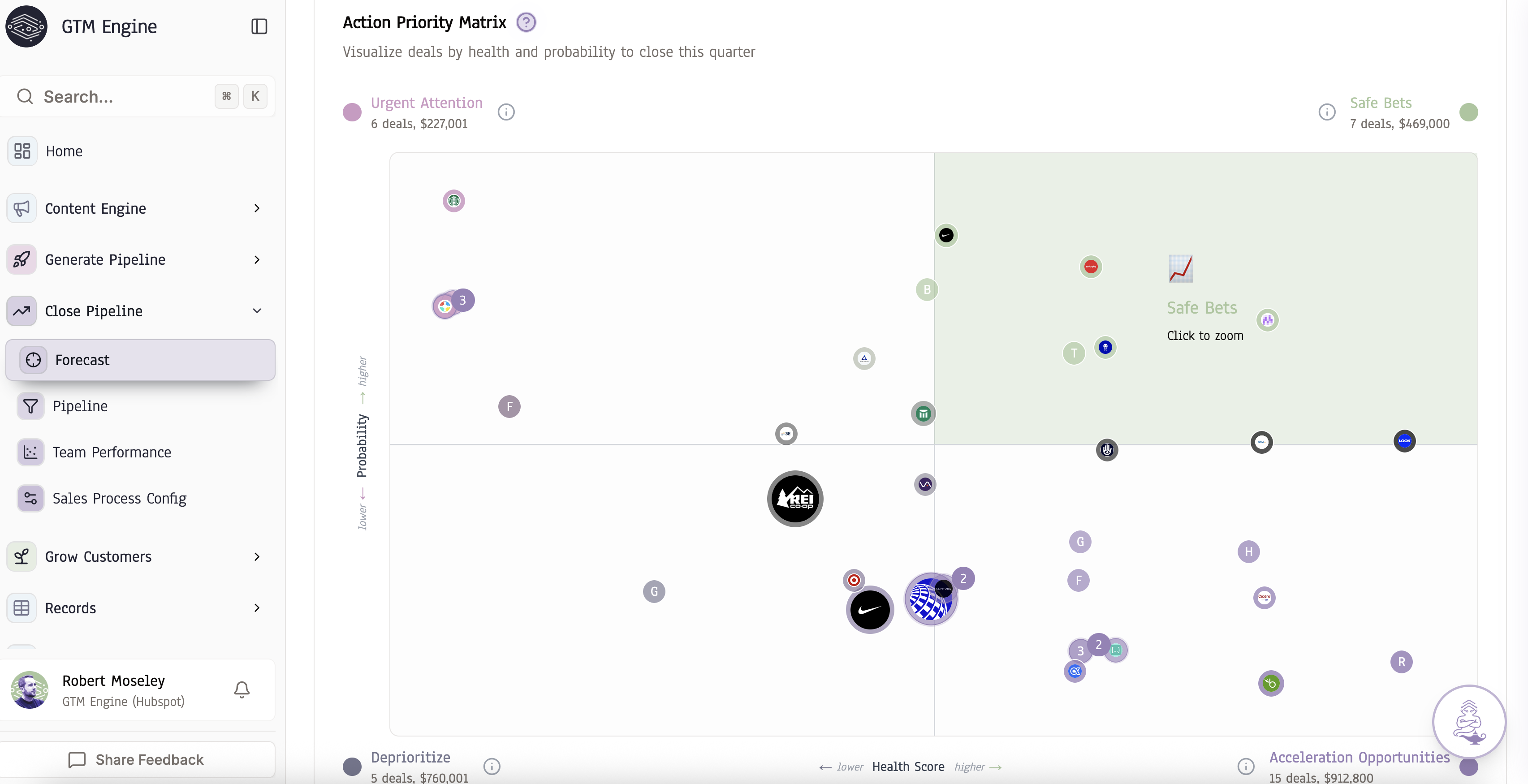
Forecast categories are mapped independently of deal stages in your field settings, and that separation matters more than it sounds. A stage named contract review does not have to mean commit. When the two are wired together, every deal that reaches late-stage paperwork inflates the commit number automatically, and the quarter looks safe until it is not.
The decision this altitude supports is whether to stand behind the number, and what your best paths to it are: which healthy deals carry it, which at-risk deals are worth saving, and which are the best candidates to pull into the quarter. Read the risk in both forms, because a deal that will not close and a deal that will close late call for different plays. Then zoom in on the deals that matter most.
Altitude Two: The Pipeline View Tells You Which Deals Are Carrying the Number
A forecast total hides the fact that five deals decide your quarter.
The pipeline view is the same quarter one level lower, with every deal color coded by its health score and an overall pipeline health read across the book. What you are looking for here is concentration: whether the number rests on three healthy deals or eleven yellow ones, and which of those you can still change with the weeks you have left.
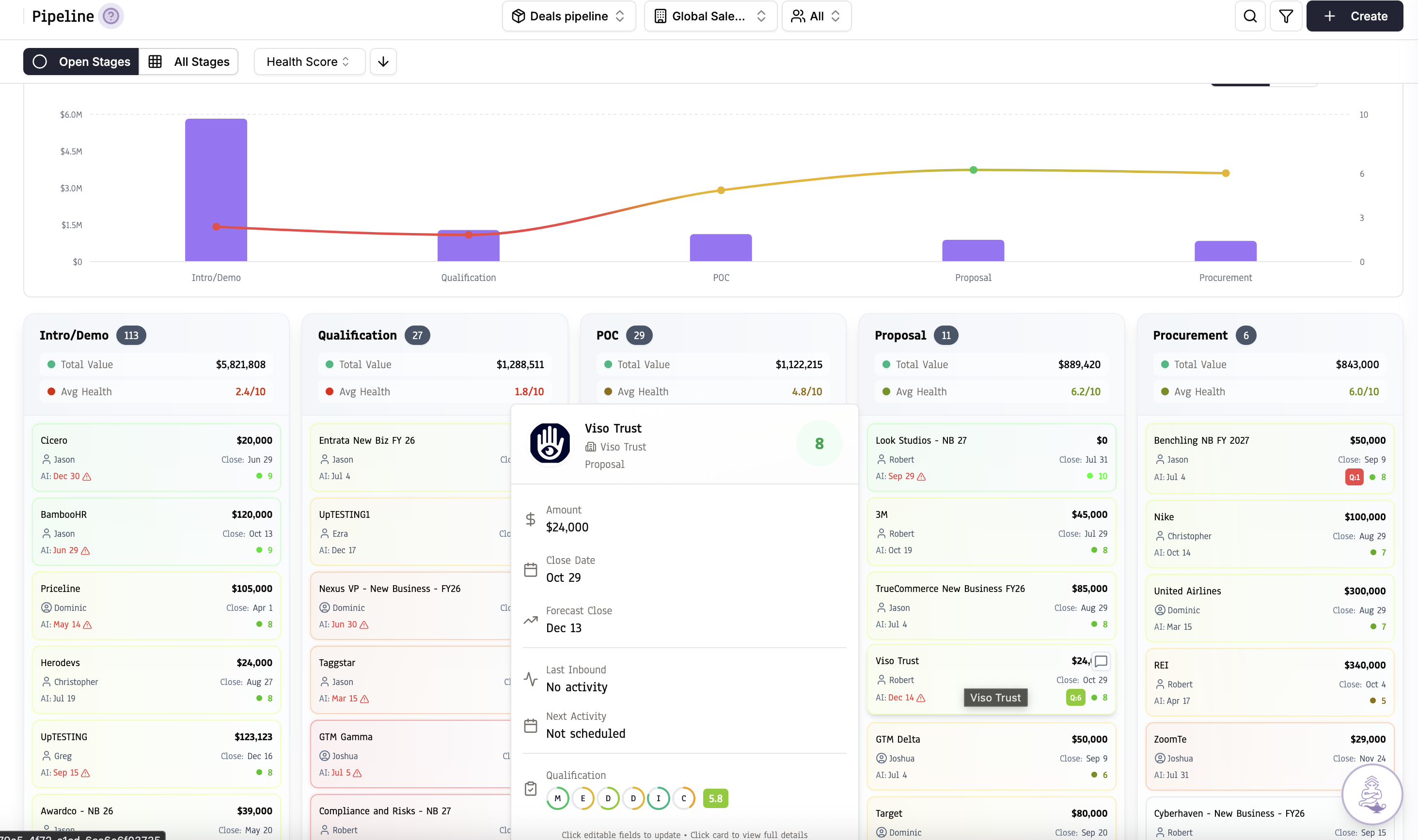
Volume is what makes this altitude necessary rather than decorative. On a call we recently had, one sales leader showed us a pipeline carrying 1,987 open deals, and the only views that turned out to be usable were the 30, 60, and 90 day horizons. That is a single account, so treat it as an anecdote rather than a benchmark, but the point holds: an unfiltered pipeline is a list, not a decision surface.
The decision this altitude supports is where the rest of your selling time goes. That is a different exercise from preparing to defend a number in a meeting, and it is the last point at which you are still working with lists instead of deals.
Altitude Three: The Opportunity Tells You What the Risk Actually Is
A deal in contract review can be the least healthy deal in your pipeline.
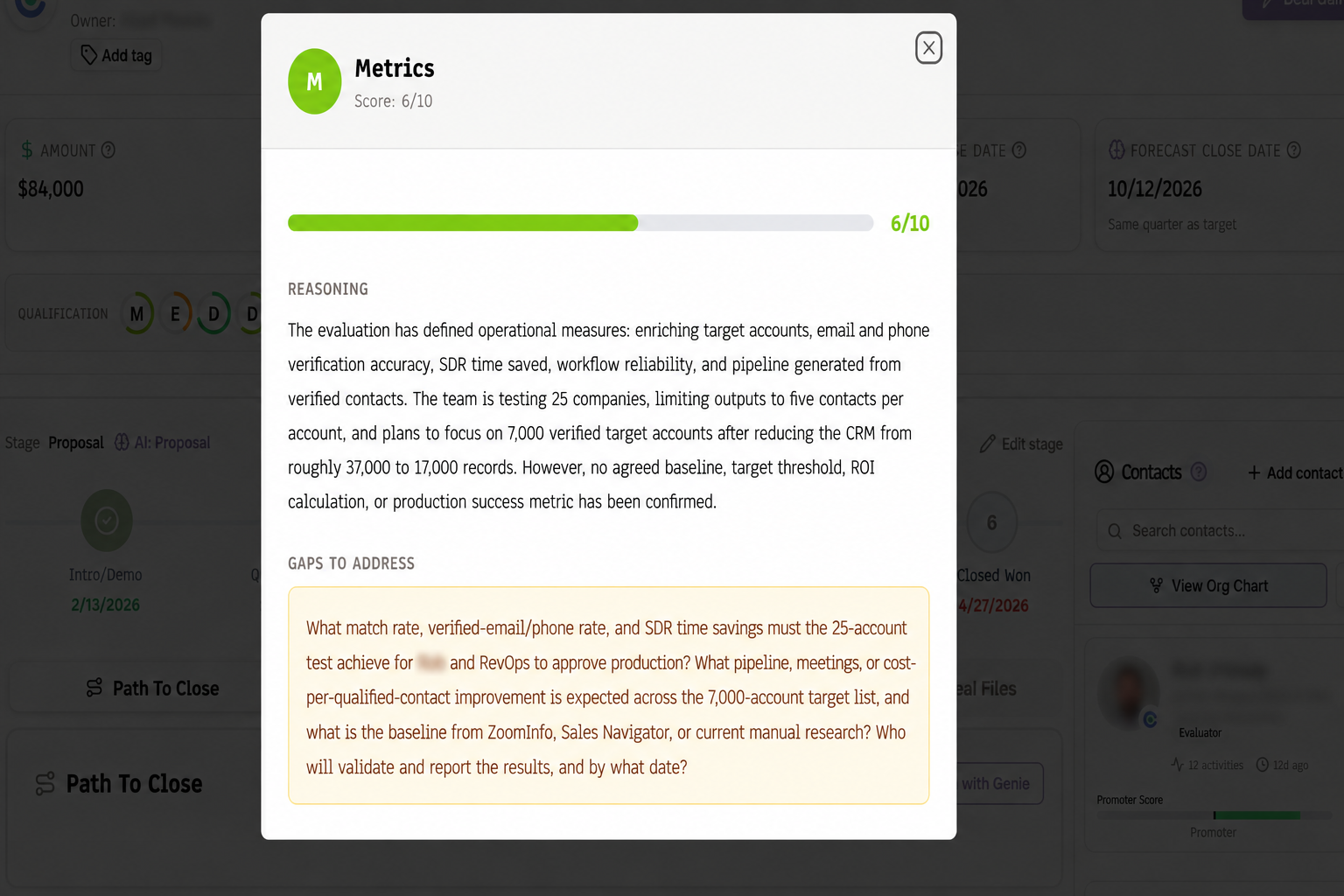
The opportunity is where stage and health come apart. Stage records where the rep last moved the deal. Health reads what the buyer has actually done. A deal can sit in contract review with no economic buyer on a single call and a champion who stopped replying two weeks ago, and nothing about its stage will tell you that. A deal health score in GTM Engine is built from captured buyer activity, so it measures the deal on the evidence rather than on its position in the process. Alongside it, deal-gap fields on the opportunity record show what is missing rather than only what is present.
Say the deal you were counting on now looks like it will land late. Open the opportunity and the reason is there, cited to the call or email where the signal came up, such as the procurement comment from three weeks ago that never reached the close date. You also see every contact who has taken part in the deal, their champion status, and where they sit in the org, so you know who the blockers are and whether the person who controls budget has shown up at all.
The part that matters when you open your own deal is that each dimension of your qualification methodology is scored separately, with the rationale shown. The readout is that the economic buyer is unconfirmed and the business impact is unquantified. That is a to-do list. A single blended score that says the deal is at risk is not.
The stage timeline adds the same specificity to timing. Entry and exit criteria come from your own sales process configuration, so stuck-stage and skipped-stage flags measure against your team's definition of a stage rather than a generic one. A deal that skipped a stage on paper usually skipped the work that stage exists to check.
A Chief Growth Officer at an education company put the status quo plainly when he told us his CRM was giving him and his team no usable insight, and that the data was largely there. Presence of data is not presence of a read on the deal.
Still at Deal Altitude, the Next Action Comes With a Realistic Timeline Attached
Diagnosis is cheap. Reps want the next move, and a close date they can defend.
The next action lives at the same altitude as the risk that produced it. Path to Close is a prioritized action plan on the opportunity, with the reasoning attached to each action and the order under your control. You can reorder it, because you know things about the account that the last three calls did not contain.
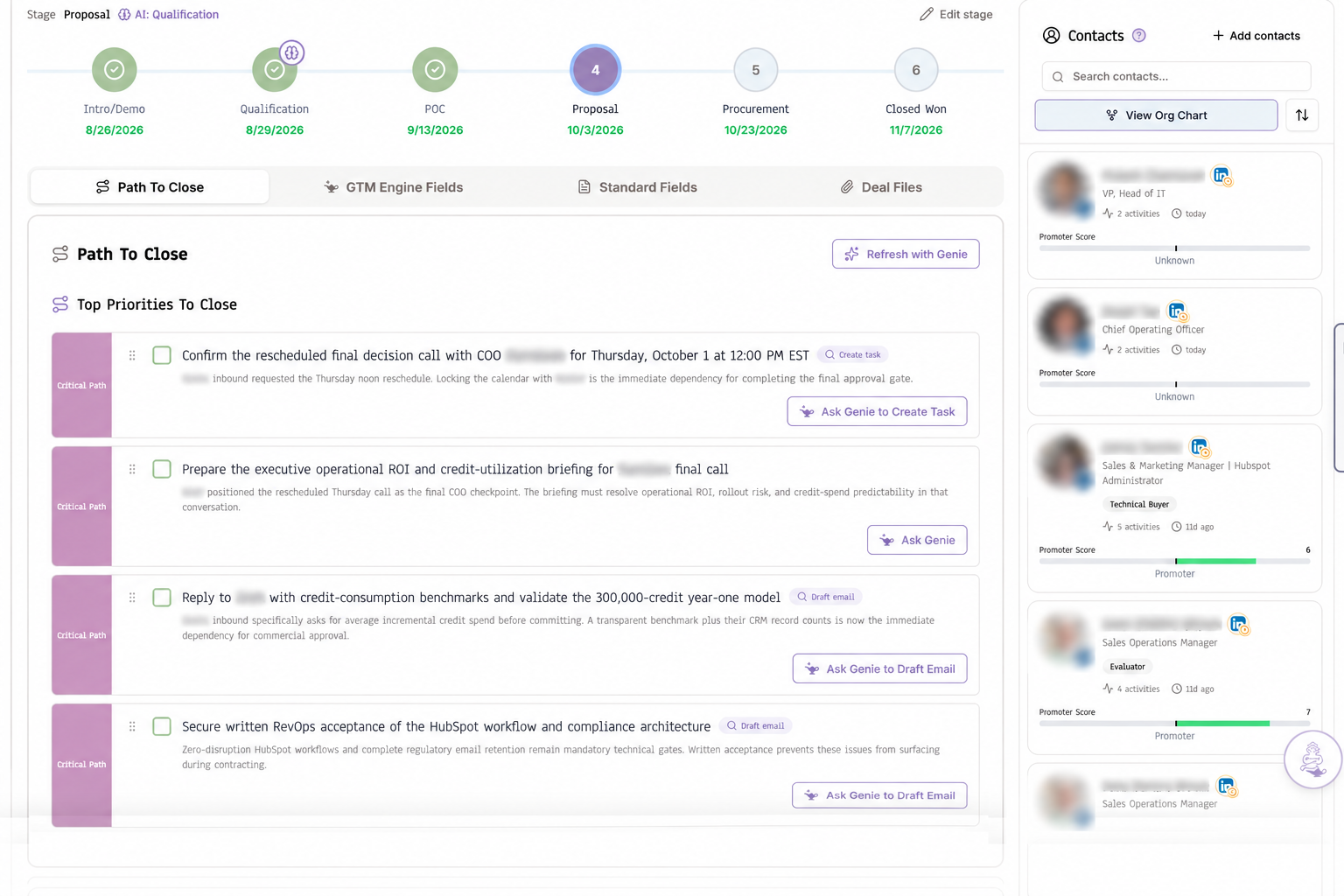
The play follows the risk. If the signal is a pricing concern, you get ahead of it while there is still time to answer it, instead of finding out on the last day of the quarter. If the risk is a missing economic buyer, the play is getting that person into the next meeting, and the contact view has already told you who they are.
Each item can be worked from where you read it. Genie will create the task, draft the email, find the contacts, or enroll someone in a campaign, so the plan does not become a second list you maintain separately from doing the work. The plan refreshes as new call transcripts and emails land, which means Monday's plan already reflects Thursday's call and the email you sent afterward.
Timing is the part that makes this defensible in a forecast conversation. A close date earns its place when it is grounded in what the buyer has actually done, not chosen because it fits the quarter.
Two surfaces carry this into the daily rhythm. The Genie Day Planner on the home page sequences the day across your book, and Meeting Prep briefings assemble what happened with the account from the activity timeline before you walk into the next call.
Altitude Four: The Calls Show Who Needs Coaching and Where Your Process Breaks
You usually find out a rep needs coaching after the deal is already lost.
The calls are where execution happens, and they close the loop the forecast opened. Most of the risks flagged earlier in this article started as something that did or did not happen in a conversation with the buyer, on a call or in an email thread: the economic buyer nobody asked for, the pricing concern that surfaced too late, the procurement timeline nobody asked about.
The calls are your game tape. On Monday morning a coaching staff watches the film to see what the team did well, what broke down, and which drills go into practice that week. The same captured calls that scored your deals do that job for your team, and nothing new is collected about anyone to do it.
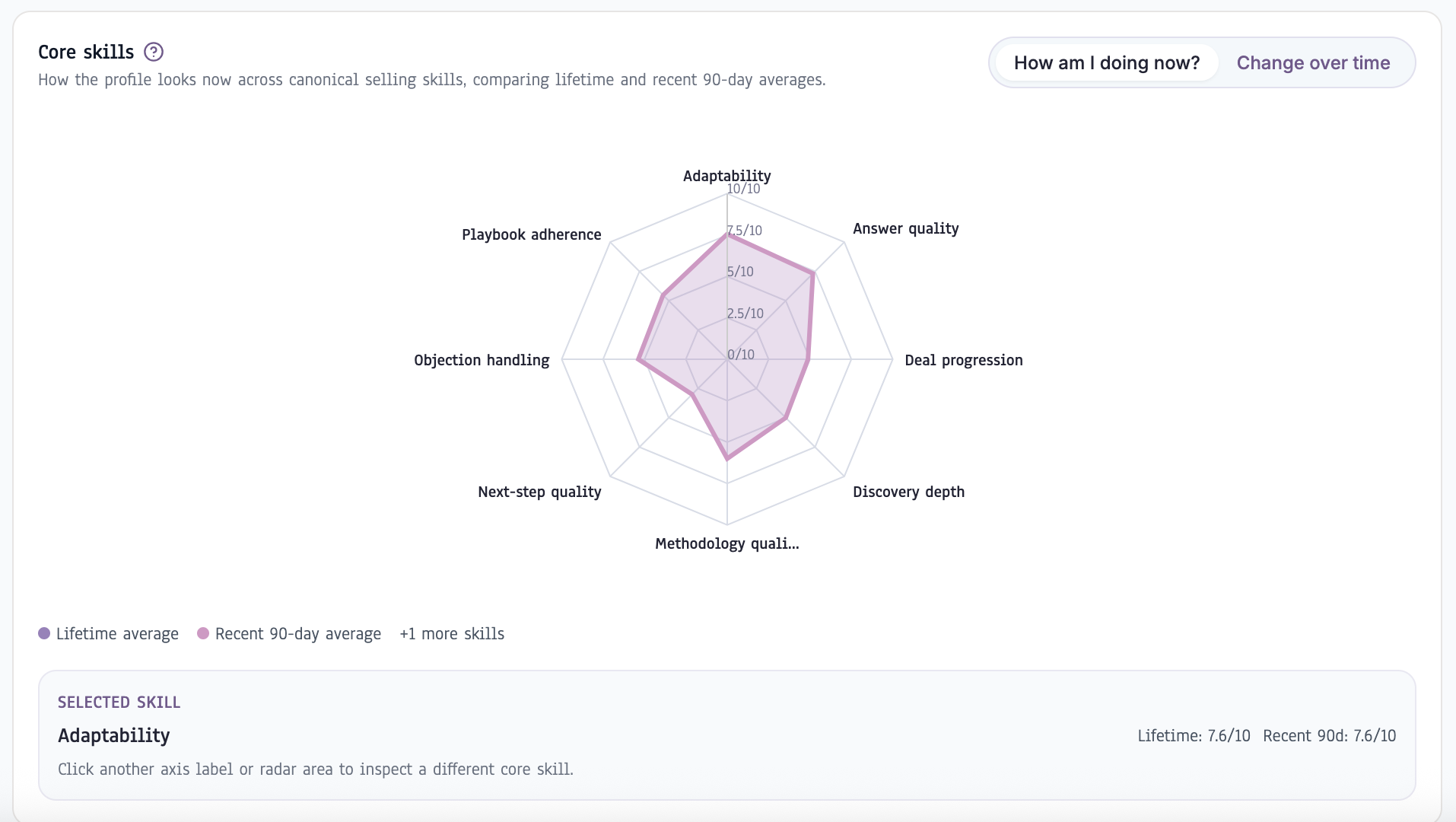
At the rep level, the tape shows who needs coaching and on what. Each rep has a skills profile that scores core selling skills such as discovery depth, objection handling, next-step quality, and adaptability, and compares the lifetime average with the recent 90-day average. A manager can see that one rep's discovery is thin across their entire book, or that another rep's next steps have slipped over the last quarter. That is a skill to build with a person, which is a different job from rescuing a deal.
Each call also gets a moment timeline that tags strengths, improvements, risks, and next steps at the timestamp where they happened, with the clip attached. On one of our own recent calls, the buyer had asked for a quote more than once, named an end-of-month decision, and mentioned a competing conversation later that week. The rep wrapped up with action items but never confirmed who owned the proposal, when it would arrive, or when the next evaluation meeting was. The timeline flagged it as a next-step moment at minute 48. That is the close-late risk from earlier in this article, caught on tape before it showed up as a slipped close date.

At the team level, the tape shows where your sales process is breaking. When deals across every rep stall in the same stage, or the whole team skips the same qualification step, coaching one person will not fix it. The cause sits in the stage definition, the handoff, or the playbook, and the fix is a process change.
Keep the two decisions separate. Deal-level risk tells a manager which play to call on a live opportunity. The pattern across calls tells them which drill to run in practice, and a review that mixes the two does neither well.
The team-level surfaces are rep comparisons on the performance view, per-dimension methodology scores that are comparable across a team, and stuck-stage and skipped-stage flags across the book. The point is catching the pattern while deals are still live rather than reconstructing the loss afterward.
A sales leader in our record wanted exactly this for a different reason. He needed something demonstrable to show a board how the culture was changing and how people were being held accountable, which a subjective forecast cannot provide.
This is what a forecast your prospects built buys you. Forecast calls stop being an interrogation about what is real, because what is real is already on the record. The time goes to calling the right plays, running them, and coaching the team, which is how you move the number instead of only predicting it.
Deal Reality Is Built From the Bottom of the Record Up
You cannot inspect your way to an objective forecast when the records underneath it are empty.
Deal reality is the state of an opportunity as your customers' own actions and words describe it. It is the one read on the deal that nobody on your team wrote, which makes it the standard every judgment on the deal gets checked against. The stage, the close date, and the rep's confidence are all judgments. The email the economic buyer never answered is a fact.
Those facts start at the bottom, in the fields on your opportunity, contact, and account records. The opportunity holds the pain, the decision process, the timeline the buyer gave, and what is still missing. Contact records hold who is involved, who is championing the deal, and who has gone quiet. The account holds the context around both. When those fields fill from what the customer actually said and did, every view above them inherits the same facts: the health score, Path to Close, the pipeline view, and the forecast page.
That foundation is your offensive line. Nobody designs the offense around the line, and nothing in the offense works without it. A great play call behind a line that cannot hold a block is still a sack, and a well-run forecast call on top of empty records is a guess with better formatting.
The records fill themselves through a connected call recorder, per-user email and calendar sync, and AI fields that populate from captured activity, plus an activity hygiene view for linking stray meetings and calls to the right opportunity. GTM Engine works with Gong, Fathom, Sybill, and Fireflies, and includes its own recorder for teams without one or those looking for consolidation.
A Chief Growth Officer described the outcome he wanted as taking the administrative work off the rep and letting salespeople focus on selling. What comes with it is a forecast your customers wrote, one that holds up when someone asks where the number came from.
FAQ
Why do I need four views of the same quarter?
They are the same quarter at four resolutions. The forecast page shows which parts of the quarter need attention. From there you zoom in step by step: the pipeline view shows which deals carry the number, the opportunity shows the specific risk and who is involved, and the calls show how your team handled each conversation and what they could improve. Because you can go from the whole field to a single conversation quickly, you can call the right plays while there is still time, knowing which deals and which reps need resources and help right now. All four views read from the same cited buyer activity, so the answer does not change as you zoom in.
How does evidence-based sales forecasting work?
Evidence-based sales forecasting is a forecast built from what buyers actually did and said, with each change traced to its source. Observed behavior is a fact: the economic buyer joined the call, the champion stopped replying, procurement named a 60-day review. A predicted outcome is a judgment built on those facts, such as a health score, a category, or a close date. Both have limits. Observed behavior only covers what was captured, so a conversation that never reached a call or an email is invisible. Predictions can still be wrong when buyers change course. The advantage is that when a prediction misses, you can see which fact it rested on and whether that fact was incomplete.
How is the deal health score built, and what happens when evidence is missing?
Each dimension of your qualification methodology is scored separately from captured buyer activity, with the rationale and source shown. When there is no evidence for a dimension, such as no economic buyer on any call, the dimension reads as a gap on the opportunity rather than a pass. That is why a thin record produces a cautious score instead of a confident one.
How is a forecast category different from a deal stage in GTM Engine?
A deal stage describes where the work is in your sales process, and a forecast category describes how confident the business is in the deal landing this period. They are mapped independently in field settings, so reaching a late stage does not automatically promote a deal to commit.
How current is the deal health score and the next-action plan?
Both are a real-time read on current state. They update as calls and emails land, including email you have just sent, so the record reflects the last real interaction rather than the last time someone did CRM maintenance.
Does this replace my pipeline review?
No. It changes what the review is for. Status is already visible before the meeting, so the time goes to deciding which plays to run and which risks need another person involved.
What happens if I disagree with the deal health score?
You argue with it using the evidence shown. Each methodology dimension is scored separately with its rationale attached, so a disagreement becomes a specific question about whether a buyer action occurred rather than a difference of opinion about a number.
Override it when you hold context the record does not: a verbal commitment in a hallway, a reorg you heard about from your champion, a budget decision made in a meeting you were not in. Put that context into the record as a note or an email recap, so the next read includes it and your manager can see why you disagreed.
What can my manager see that I cannot?
Managers see the same deal evidence you do, plus the pattern across the team. That comparison is what makes coaching specific to a skill instead of a lecture about updating the CRM.
What does GTM Engine need connected before the forecast is trustworthy?
A call recorder, per-user email and calendar sync, and a sales process with real entry and exit criteria for each stage. Without the first two the record is incomplete, and without the third the flags have no standard to measure against.
About the Author

Robert Moseley IV is the Founder and CEO of GTM Engine, a pipeline execution platform that’s changing the way modern revenue teams work. With a background in sales leadership, product strategy, and data architecture, he’s spent more than 10 years helping fast-growing companies move away from manual processes and adopt smarter, scalable systems. At GTM Engine, Robert is building what he calls the go-to-market nervous system. It tracks every interaction, uses AI to enrich CRM data, and gives teams the real-time visibility they need to stay on track. His true north is simple. To take the guesswork out of sales and help revenue teams make decisions based on facts, not gut feel.


