

TL;DR
Executive reports are only as trustworthy as the opportunity record behind them. Stage, close date, and amount are the fields a CRO has to defend in the boardroom, and reps type them in under time pressure and optimism, not under oath. Parsing the content of calls and emails as they happen writes those fields from what a buyer actually said, not from a rep's guess. That is a double win: the CRO gets a forecast grounded in evidence instead of an estimate, and the rep gets back the manual update work they were never good at in the first place. A report is boardroom-ready only when it can show what it includes, where it came from, who owns it, how fresh it is, and what it leaves out.
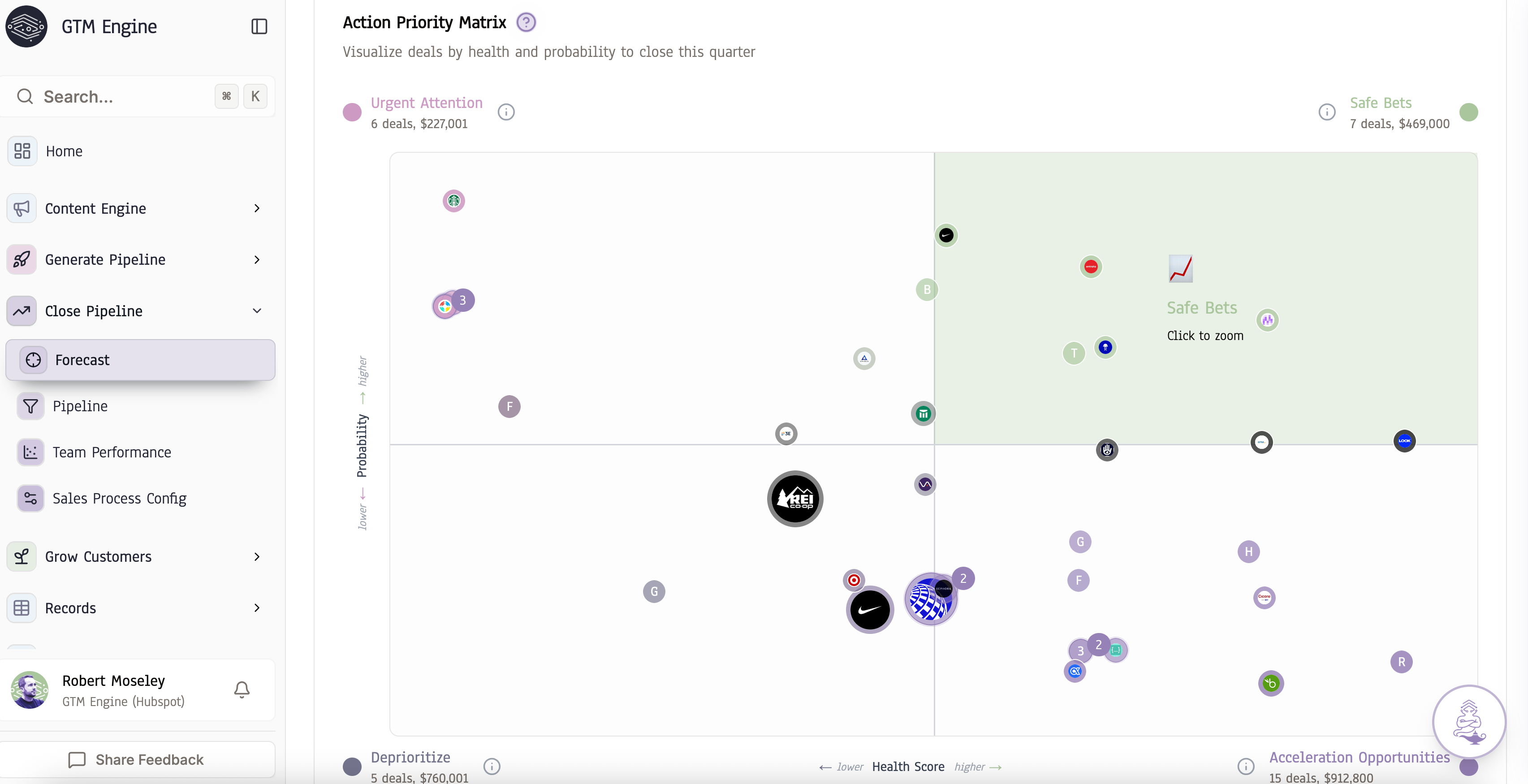
Trusted executive reports begin with trusted CRM data
You cannot make a good decision from a number you do not trust.
I have sat in enough leadership meetings to know the moment: someone puts a pipeline number or a market-coverage count on the screen, and before anyone reacts to it, I am asking myself whether I believe it. CRM data is the structured record of accounts, contacts, activity, opportunities, and deal signals a sales organization uses to do its work and report on performance. A report is only a summary of that record. It cannot correct a duplicate company, a missing contact, or a customer interaction that never made it into the system.
A sales operations analyst at a mid-market software company, in a call earlier this year about her team's Salesforce cleanup, put the doubt plainly: "we have a very small little problem of 38,000 companies where... some of you guys are the same, some of you are related, some of you are ghost, like shell companies, holding companies or you have been acquired at some point." The cleanup fed the numbers she sent upward. "We can run reports and be sure that the information we're sending up the ladder to senior leadership... is that even right? Do I trust that information?"
That is one account, not a market benchmark. But anyone who has to stand behind a board number faces the same question: what is this count actually made of, and would it survive someone asking to see the list?
The opportunity record is where executive trust actually breaks
A rep's stage and close date are a claim, not a fact, until something backs them up.
Account hygiene matters, but it is not where a CRO's real exposure lives. The record I have to defend in front of the board is the opportunity: the stage, the close date, the amount, the qualification score. Those fields are only as good as what the rep typed into them, and reps type under time pressure and optimism, not under oath.
A colleague of mine lived this firsthand as a sales leader at a previous company, a legal AI startup selling into law firms and in-house legal teams. A board meeting produced an offhand question: what percentage of pipeline was in-house legal teams versus law firms? Nobody had that field on the opportunity, so it went to the Salesforce admin, and a ticket backlog meant it took two weeks just to create it. The team was asked to backfill it and mostly did not. A stage gate went in next, blocking deals from advancing without the field filled in, and compliance improved but stayed short of universal. When the report finally existed, three months later, nobody believed the number, because nobody could say how it got built. That is a trust problem, and it started at the opportunity.
Activity counts and last-touch dates do not fix this. Knowing a rep made four calls this week tells you effort happened. It does not tell you what was said, whether budget is real, or whether the champion is still engaged. Those answers live inside the activity itself: the call transcript, the email thread, the sentence where a prospect said they could not get budget approved.
Reading the content of activity changes the close date
The forecast should move because of what was said, not because a stage got dragged.
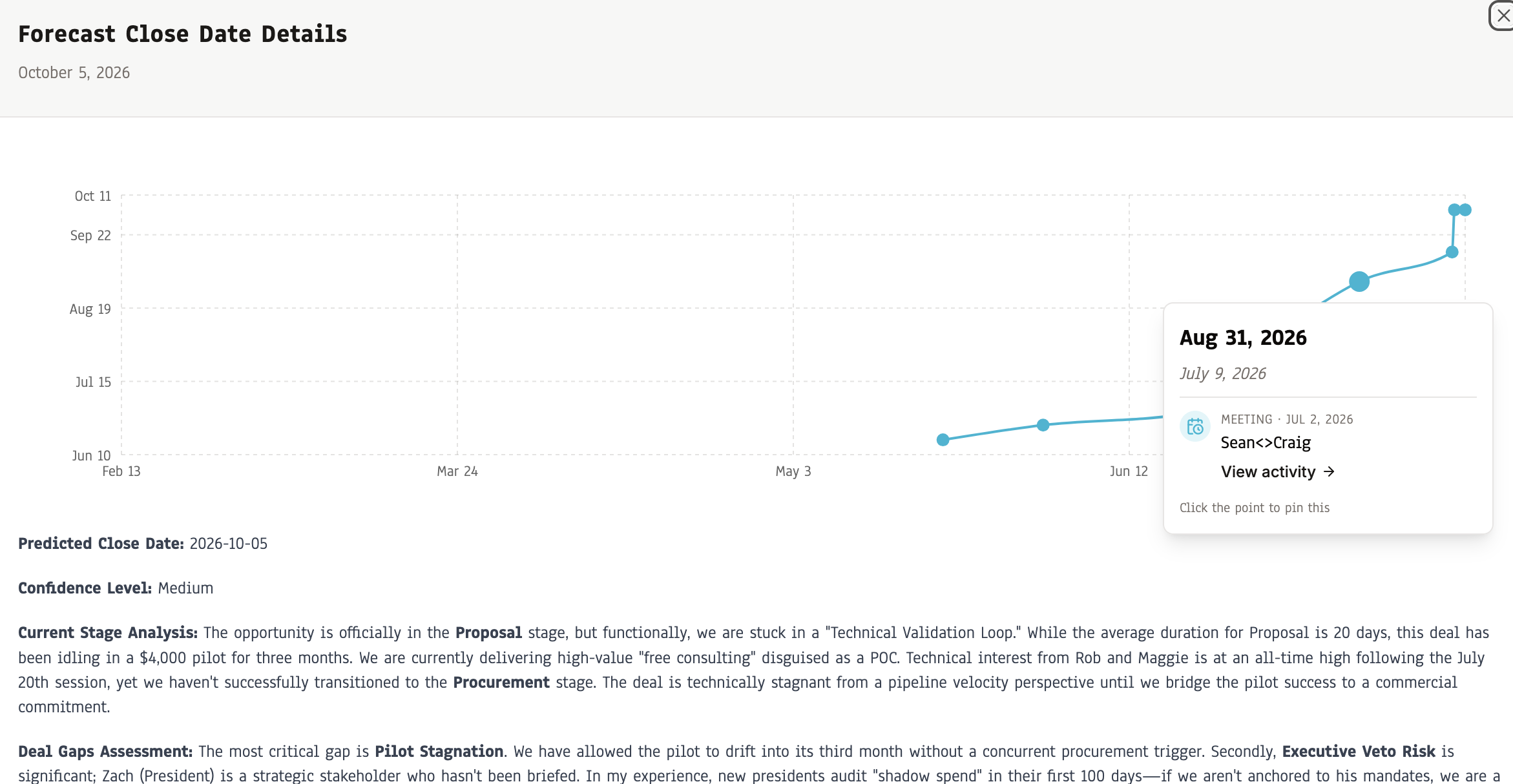
In the same walkthrough, a forecast close date moved out two months, and the reason traced to a single line in an email: the buyer said they could not get budget. The system surfaced that exact email, the exact words, and the resulting forecast change side by side. That is a different kind of report than "rep says 70% confidence." It is a claim with its evidence attached.
The same principle applies to third-party signals. Recent funding, hiring surges, and expansion announcements can indicate whether an account is ready to buy, but only if they are sourced and dated rather than asserted. A propensity signal built from a funding round or hiring surge is only useful to a CRO if it traces back to the specific filing, job posting, or news item it came from, the same way a call-driven field change traces back to the email or transcript that produced it.
Parsing activity content into the record as it happens gives the CRO a defensible fact instead of a rep's estimate, and it removes the rep's manual step of typing the update in. Software reads the call transcript or email thread and proposes a field value. A rep or manager still has final say on what gets kept. That distinction, extraction versus approval, is what keeps the field trustworthy. Extracted fields should carry a way to see the source excerpt behind them and a way to flag or correct an extraction that got it wrong, the same way you would want a right of reply against any analyst's footnote. Parsing removes the rep's typing, not the need for field-level governance over what got parsed and why.
Not every field on the opportunity deserves the same confidence, and a report should say which kind of field it is looking at. A fact is something a person said or wrote, in a call transcript or an email, that gets pulled into a field verbatim or near-verbatim: "budget is not approved" is a fact. An inferred signal is a third-party data point plus a judgment call about what it means: a hiring surge suggesting expansion is an inference, not a fact, no matter how confidently it is scored. A rep's own entry, the stage, the confidence percentage, the qualification score, is judgment, and it deserves the least automatic trust of the three until something backs it up. A board deck that treats all three the same way is the exact problem this piece opened with.
Complete, clean records make reports defensible
A forecast cannot defend activity your CRM never recorded, and a company count is only as good as the companies behind it.
A CRM report is only as complete as the interactions and updates feeding its fields. When activity capture is incomplete, that gap should be visible in the report, not smoothed into a confident score.
The same account offers a related problem: contacts that entered the CRM through a meeting invite often arrived with an email address and nothing else. "We end up with people that have no job titles." That gap seems small until a leader tries to use those contacts to answer a real question: "We met with 500 people last year. Who were they? If I've got a bunch of blanks, it's not good for me and it's not good for feeding back to the team."
Before treating a company count as evidence, it is worth checking whether the underlying accounts are duplicated, related, acquired, or simply irrelevant. A leader at a different stage of the same account's cleanup put it plainly: "we've got a bunch of companies that don't have contact data... a bunch that have outdated contact data... maybe are no longer relevant in our CRM and they're just creating a bit of noise." A name and an email address are not enough to support a segmentation claim if the role is missing. Cleanup is not a one-time event; it is an ongoing standard applied the moment a record enters the system, not months later during an audit.
A number that cannot say what it excludes is an estimate wearing a fact's clothing. Take a single line on a forecast slide: "$40K, closing this quarter, 70% confidence." Before that line reaches the board, it should be able to answer five questions: Source — Forecast amount, tied to a specific opportunity record. Evidence — The email or call where budget, timeline, or approval was actually discussed. Owner — The rep, verified by a manager. Freshness — Last activity date on the opportunity. Exclusions — Deals with no activity in 30 days, flagged separately rather than folded into the same confidence number.
A report missing any one of these five is not lying. It just has not earned the confidence it is claiming.
Automation without ownership just moves the mess faster
A governed workflow beats five tools with five versions of the same deal.
When prospecting, outbound tools, email, calling, and the CRM each hold a different piece of the account's history, the organization ends up with competing versions of what happened. The fix is not another tool for reps to update. It is one dependable record, governed by a clear rule for which system owns which field and how conflicts get resolved.
That governance is not automatic just because a workflow tool exists. The same account that surfaced the data-quality problems above also described the difficulty of getting automation to behave: "we're just kind of struggling a little bit with the automation side of it, how to build out the workflows correctly so that they all layer on top of each other and we actually achieve what we want." Automating a process does not repair a process that was never defined.
Security and compliance review carries the same discipline. One prospective account, a healthcare-adjacent software vendor evaluating automated activity capture this year, stalled here: before broader adoption, its IT security team required a review covering SOC 2 Type II, GDPR, and HIPAA considerations. That review is a real gate, and it belongs before rollout, not after.
Automation does not guarantee accurate data, and it does not replace Salesforce, HubSpot, your data governance function, or your own judgment as an executive. What it changes is the traceability of the record: when a field updates, the system that updated it should point back to the call or email that changed it, the same way a good analyst footnotes a claim. Before rollout, a CRO should be able to name who owns each field the system touches, what confidence threshold triggers a human review, and how long the source call or email stays accessible if someone challenges the number later. That checklist, not the tooling, is what makes a report defensible. It does not replace the judgment call about whether the number is the right one to report.
FAQ
What is CRM data quality? CRM data quality is whether the accounts, contacts, opportunities, and activity records in a CRM are accurate, complete, current, and free of duplicates, so reports built from them can be trusted.
What is CRM data in sales? CRM data is the structured account, contact, activity, opportunity, and deal information used to manage sales work and report performance.
What is the main source of data for CRM reports? CRM reports draw from the fields and activities stored in the CRM, so their reliability depends on how completely and accurately customer interactions update those records.
How do you make sure CRM data is accurate? Define field ownership, validate required fields, detect duplicates and obsolete records, monitor update freshness, and disclose activity gaps before relying on a report.
How do you maintain CRM data accuracy over time? Treat cleanup as ongoing rather than a one-time project: validate new records as they enter the system, re-check freshness on a schedule, and require an owner for any exception that would otherwise sit in a report indefinitely.
Can incomplete activity support a trustworthy score? Only if the score clearly states its available inputs, its missing signals, its assumptions, and its resulting level of confidence.
About the Author

Craig Witt is a seasoned revenue executive and GTM advisor with more than three decades of experience building, scaling, and leading enterprise software sales organizations. He has held senior revenue leadership roles across companies including Compliance & Risks, MotionPoint, Ventiv Technology, VersionOne, TIBCO, Software AG, Business Objects, Quest Software, and OpenText. Throughout his career, Craig has led global sales teams, owned full revenue P&Ls, and helped organizations strengthen go-to-market strategy, sales execution, forecasting, and operational discipline.
As a consultant to GTM Engine, Craig brings a CRO’s perspective to helping revenue teams turn data, process, and customer intelligence into better outcomes. He is especially focused on practical ways to improve pipeline quality, seller productivity, account prioritization, and forecast confidence without adding unnecessary complexity for reps or RevOps teams. Craig is known for his direct, execution-oriented approach and his belief that strong culture, clear strategy, and consistent accountability create elite results.


