

TL;DR
A segment nobody reviewed is a liability with a filter on it. Clean CRM data gets you a list, but the list only turns revenue data into action when it passes through exclusions, a named owner, an approval and a stop condition before anyone sends, publishes or dials.
Here's what you'll learn in this article:
- Why a reviewed action, and not a list, is the unit of work for revenue data
- The five parts every reviewed segment needs before it triggers anything
- Why a champion is permission to ask for a case study, not approved customer proof
- How to build a closed-lost relight campaign that suppresses duplicates, active deals and contacts without consent
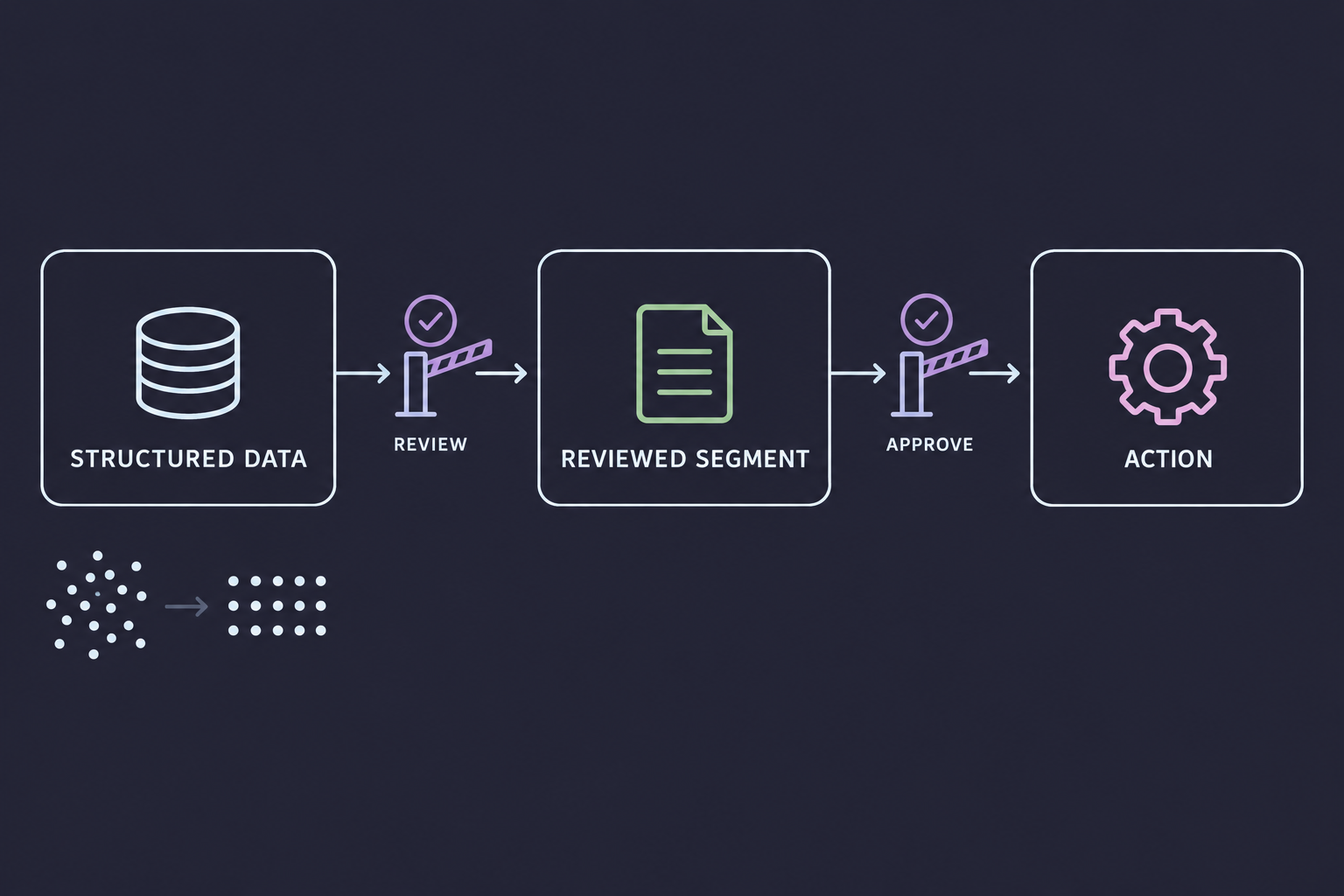
Revenue data pays off only when a reviewed segment ends in an owned action
You cleaned the CRM, built the report, and now the list sits in a spreadsheet that nobody owns.
Revenue data pays off at exactly one point: when a reviewed segment becomes an action with a person's name on it. Everything upstream, including enrichment, dedupe, activity capture and field hygiene, is a cost until that moment. A reviewed action is a change to the outside world (an email, a published asset, a call task) triggered by a segment that a named person has checked against exclusions and approved, with a defined condition that stops it.
Picture the usual version. Someone asks for "every closed-lost opportunity from last year," exports the rows, and drops them into a sequence on a Tuesday. By Wednesday, one of those contacts is in an open deal with another AE, one has changed companies, and one asked months ago to never hear from you again. The data was fine. The process skipped the part where a human looks at it.
Operators feel this as a trust problem before they name it as a process problem. During an October 2026 working session, Keenan, a sales leader at ASG, put it bluntly about a record missing his earlier conversations: "I can't trust this right now because it doesn't have all the information, so I don't trust it." That instinct is correct. A segment built on partial records will act on partial records, and the customer is the one who notices.
A list is a question. A reviewed action is the answer, with an owner.
Every reviewed segment needs criteria, exclusions, an owner, an approval and a stop condition
If you can't name who approves the list and what stops it, the list will keep running until a customer complains.
A reviewed segment is a filtered set of records that has five things attached before it is allowed to trigger anything. Each one is a separate control, and each catches a different failure:
- Criteria: the rule that defines who belongs, written down in plain language so a second person can check it.
- Exclusions: the rules that remove people who match the criteria but should not be touched, such as duplicates, open deals and opt-outs.
- Owner: one named person accountable for the segment's output, usually the account owner rather than whoever built the report.
- Approval: an explicit yes from that owner (and, for customer proof, from the customer) before anything leaves the building.
- Stop condition: the event that pulls a contact out mid-flight, such as a reply, a new opportunity or an unsubscribe.
Timing matters more than people expect. An exported CSV is a photograph of your CRM, and by Thursday it is a photograph of someone else's CRM. Exclusions applied at export time are already stale when the third email goes out. In GTM Engine, campaign audiences can be built from filters or a plain-language description, and the query runs at send time, not when you build it. On a call with Upside in October 2026, Spencer Smith asked what happens if a scheduled contact gets a fresh touch before the send date; the answer was that the runtime query drops them.
Runtime queries do not replace the owner. Software applies the rules you wrote. It cannot tell that the "closed-lost" account is in a quiet procurement restart that the AE hasn't logged yet. The review step exists for exactly the knowledge that isn't in the CRM.
Champion lists produce case-study briefs, not approved customer proof
Marketing wants logos, CS wants to protect the account, and your champion list is where those two collide.
A champion is a contact whose recorded calls and emails show consistent advocacy for your product inside their own company. That evidence is valuable, and it is also exactly where teams overreach. A champion praising you on a QBR call has given you permission to ask. They have not given you permission to publish their words, their logo or their numbers.
The reviewed version of this workflow has a clear sequence. Start with evidence: contacts with strong promoter signals, quotes cited back to specific transcripts, and healthy account status. Then exclude accounts with an open support escalation, a renewal in active negotiation this quarter, a contract clause that restricts logo use, or a champion who has changed companies. GTM Engine keeps one contact record when a person moves employers, with the old history attached and a new primary account association, so a champion who left is visible instead of silently orphaned.
Next, assign the owner. That should be the CSM or account owner, not marketing, because they carry the relationship risk. The output at this stage is a case-study brief, drafted from the cited transcripts, with every quote labeled as an unapproved draft. GTM Engine's Content Engine suggests case-study ideas from recorded conversations and drafts from those sources, which makes the brief fast. It does not make the brief approved.
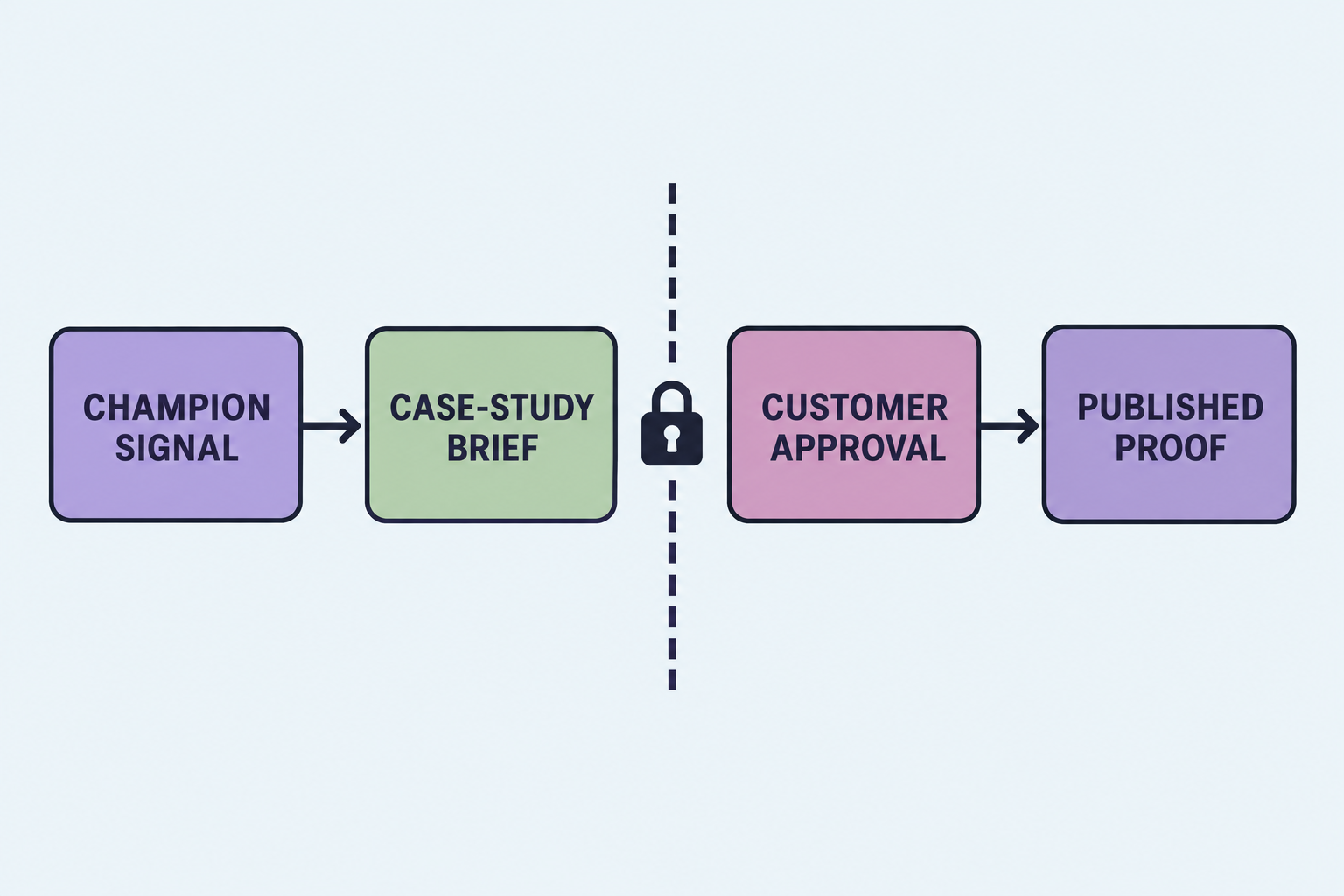
Approval belongs to the customer, in writing, covering the exact quotes, metrics and logo usage, and often routed through their comms or legal team. The stop conditions are simple: the customer declines, the champion leaves, or account health drops while the brief is in review.
One honest caveat on the evidence layer: promoter scores depend on activity being correctly associated to the account. On the same ASG call, the team found scores not appearing despite available activity data and had to investigate the sync. A missing score is a data gap, not a detractor signal, so a person should check it before an account gets dropped from the list.
A champion is a lead for a case study. Proof starts when the customer signs off.
Closed-lost relight campaigns fail on suppression before they fail on copy
The worst relight email is the one that lands on a buyer who is already in a live deal with your other AE.
A relight campaign is outreach to eligible contacts at accounts whose opportunity closed lost, timed to a change that makes the original "no" worth revisiting. The instinct behind it is sound. Celeste, on the ASG revenue team, described a lost deal during the October 2026 session this way: "It's already gone closed, lost, but we could still use it." She's right. The risk sits in who gets the email, not what it says.
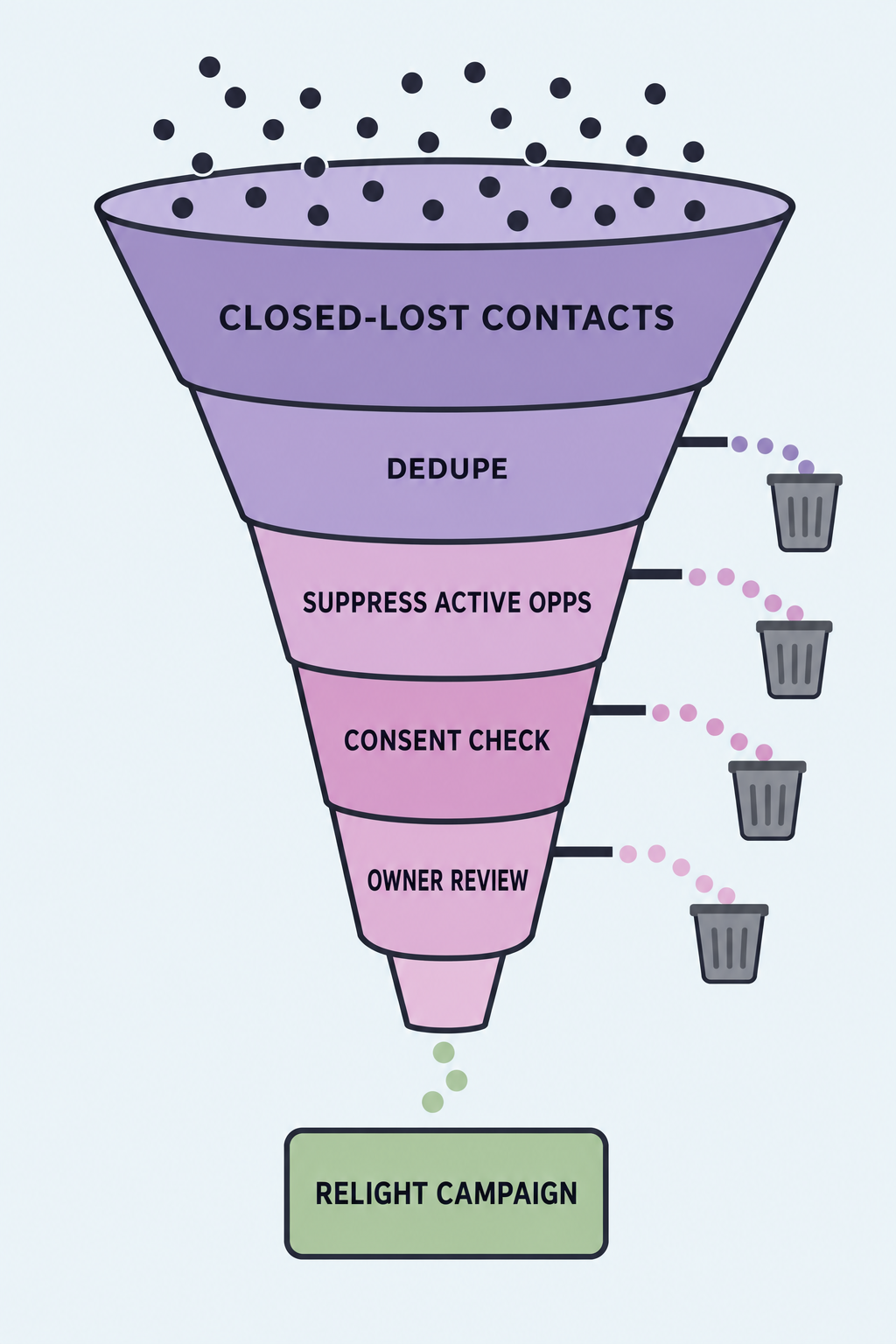
That risk is sharper when your market is small. Spencer at Upside described the barrier plainly: "irritating prospects who are already, you know, slow to engage on stuff." In a narrow TAM, one badly targeted relight burns a contact you'll need again in two quarters. Run the exclusions in this order, because each one shrinks the list the next one has to process:
- Deduplicate by person, not by email. A contact who moved from one company to another can appear twice. Match on the person record so the relight goes to their current company once, with history intact.
- Suppress active opportunities. Remove any contact whose current account has an open opportunity, plus anyone already enrolled in another campaign. GTM Engine has a setting to skip contacts active in other campaigns, so prospects don't get hit by several uncoordinated sequences at once.
- Check permission and consent. GTM Engine appends an unsubscribe link and excludes unsubscribed contacts automatically. Regional consent rules and contract terms stay with your team.
- Route to the owner for review. The AE who lost the deal, or their manager, reads the loss reason. "Lost on price" and "lost because the champion left" are relight candidates. "Asked us to stop" is not.
Copy is the easy part once the list is right. GTM Engine live campaigns can choose among templates you have already approved, using each contact's role and history to pick, so the message is personalized without anyone writing new copy at send time.
Stop conditions need the same care as entry rules. Remove-on-reply is a built-in option. If you need other stop rules, such as pulling a contact the moment a new opportunity opens, test them on a small batch before launch. Campaign stop behavior came up as a concern on a customer call in October 2026, and you want to find the edge case before a buyer does.
GTM Engine automates suppression, and your team owns approval and judgment
Before you build either workflow, know which steps the software handles and which ones depend on a person doing their job.
Supported workflows are the parts GTM Engine runs today, as shown on customer calls in September and October 2026. Proposed workflows are the processes you design on top. Keeping those separate keeps you honest with your own leadership and with buyers.
| Step | What GTM Engine supports | What your team owns |
|---|---|---|
| Build the segment | Filter or plain-language audiences; Genie reports such as "show me closed lost" | Eligibility rules and loss-reason categories |
| Exclusions | Suppression lists, overlap removal, queries run at send time | Deciding what is excluded and why |
| Dedupe | One contact record across company moves, with history | Fixing CRM sync rules that block writes |
| Active-deal suppression | Runtime filters; skip contacts in other campaigns | Flagging early deals that aren't logged yet |
| Consent | Unsubscribe link appended and honored automatically | Regional consent rules and contract terms |
| Approval | Approved template library; AI picks among approved templates | A named approver; written customer sign-off |
| Stop | Remove contact from campaign on reply | Additional stop rules, tested before launch |
| Case-study brief | Content Engine ideas and drafts from cited transcripts | Customer approval of quotes, metrics and logo |
The dedupe row has a real tradeoff attached. On the ASG call, HubSpot contact fields set to read-only caused GTM Engine to sync partial records, which then broke activity association downstream. The fix was a permissions change in HubSpot, but nobody would have caught it without a person looking at a record that seemed wrong. Review steps catch configuration problems, not only targeting problems.
Review-before-send approval is the other row to watch. Craig Witt, who runs outbound at GTM Engine, still reads and lightly edits AI-researched emails before they go out, and dedicated review-before-send controls were being finalized during the same October 2026 period. If your process depends on a hard approval gate in software, confirm it is enabled in your instance before you rely on it.
Skipping review moves the cost onto the customer
Every gate you skip still gets enforced, just by the buyer, in their inbox, on your brand.
Foundation work like dedupe, activity association and field hygiene earns nothing on its own. It earns its keep when a reviewed segment spends it on a decision a customer will see. The gates in both workflows are cheap: a few minutes of an AE's time on a loss reason, a CSM's yes on a champion, a test batch before the stop rules go live.
Skipping them costs more, later. It shows up as a burned contact in a small market, a customer who finds their quote in a deck they never approved, or an AE who learns about the relight from their own buyer.
The drop-out count at each gate is also the most honest data quality report you will get this quarter. If dedupe removes a fifth of your closed-lost list, that tells you more about your CRM than any field-completion dashboard does.
Here is the next step. Pick one closed-lost cohort, such as every opportunity that closed lost in Q2 2026. Run it through the four exclusions above, write down how many contacts drop out at each one, and send the surviving list to the owning AEs for review before any copy gets written.
Frequently Asked Questions
What is the difference between a segment and a reviewed segment?
A segment is a set of records that match a filter. A reviewed segment adds exclusions, a named owner, an approval and a stop condition, so a person has checked it and something defined will pull contacts out once it is running.
Can we use a champion's quotes from sales or CS calls in a case study without asking?
No. Recorded call language is evidence that a customer might be willing to go on record. Publishing it requires the customer's written approval of the exact quote, any metrics and any logo use, usually through their comms or legal team.
How soon after closed-lost should we relight an account?
Tie the timing to a change, not a calendar. A new executive, a funding event or a competitor contract coming up for renewal are better triggers than a fixed interval. If you do use a time rule, Spencer at Upside used 120-plus days of inactivity as his threshold for re-engagement, which is a reasonable starting point to test.
Does GTM Engine send relight emails automatically?
It can. Live campaigns run multi-step sequences, choose among approved templates per contact, and remove contacts on reply. Whether they send without a human check is your call; for relights, we recommend owner review of the list and a small test batch first.
How should we handle contacts who changed companies?
Treat them as one person with a new employer. GTM Engine keeps a single contact record with prior activity attached and a new primary account, so the AE sees the full history before approving outreach. The old company's closed-lost status does not make the new company eligible, so run the new account through the same exclusions before the contact gets a relight.
If you want to run the closed-lost cohort exercise on your own data, ask your GTM Engine account team for a working session on audiences, suppression lists and campaign stop rules.
About the Author

Robert Moseley IV is the Founder and CEO of GTM Engine, a pipeline execution platform that’s changing the way modern revenue teams work. With a background in sales leadership, product strategy, and data architecture, he’s spent more than 10 years helping fast-growing companies move away from manual processes and adopt smarter, scalable systems. At GTM Engine, Robert is building what he calls the go-to-market nervous system. It tracks every interaction, uses AI to enrich CRM data, and gives teams the real-time visibility they need to stay on track. His true north is simple. To take the guesswork out of sales and help revenue teams make decisions based on facts, not gut feel.


